Key Takeaways
- •DTU patent adds XY‑movable optics with adjustable focal point
- •Integrated detector enables real‑time monitoring of cure and substrate
- •Targeted at high‑precision, low‑volume parts rather than speed
- •Potential licensable technology for Formlabs, 3D Systems, micro‑fabrication
Pulse Analysis
Vat photopolymerization has become the workhorse of additive manufacturing, with SLA, DLP and MSLA each balancing speed, cost and resolution. Traditional SLA sweeps a laser across the resin surface, while DLP and MSLA project an entire image, delivering rapid layer cures but limited control over local exposure nuances. As industries push toward micro‑optics, biomedical devices and other high‑precision parts, the need for finer, adaptive curing strategies grows, exposing a gap that the DTU concept aims to fill.
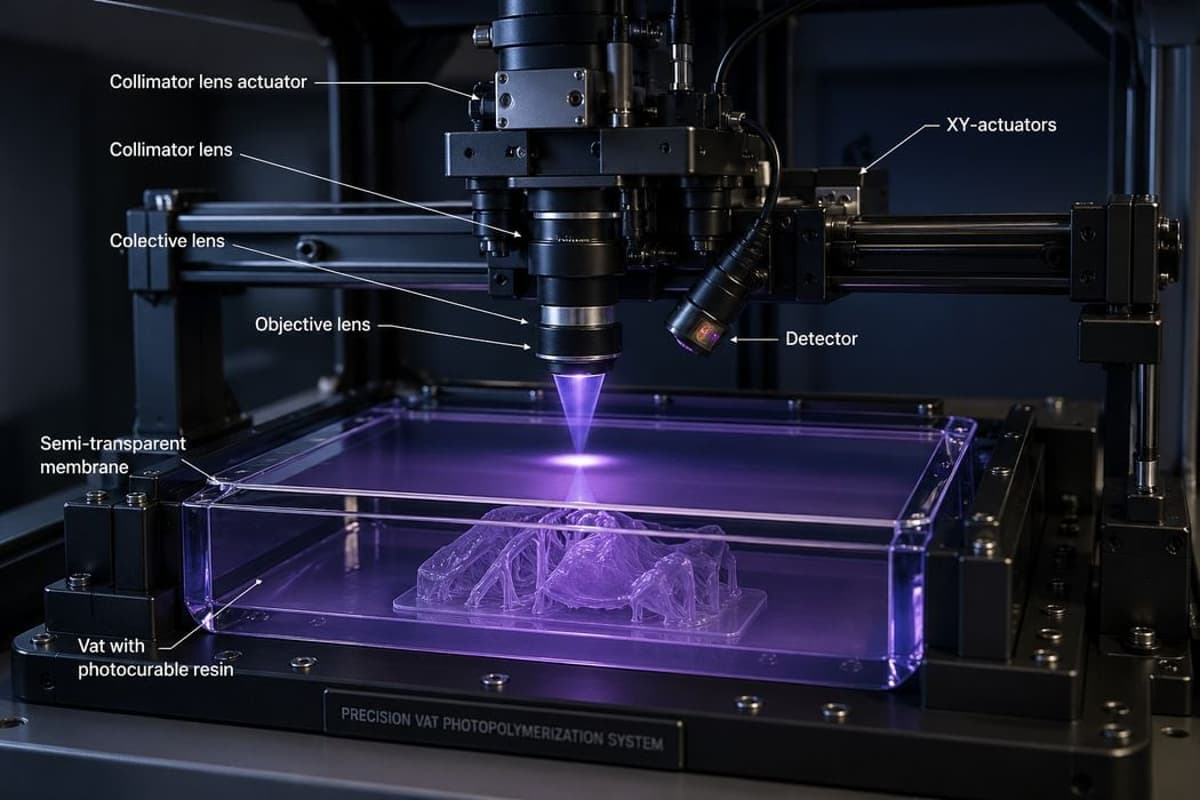
The DTU patent proposes a hybrid architecture where the optical head travels in the XY plane and, crucially, can adjust its focal distance on the fly via a collimator lens actuator. This dynamic focus enables the printer to concentrate energy exactly where needed, compensating for geometry changes, membrane interference, or variations in resin depth. Coupled with an integrated detector that can sense cure progress, surface height or substrate condition, the system promises closed‑loop control that could tighten tolerances and reduce post‑processing. However, the added mechanical motion introduces latency; unless the head can move at high speed, overall build times may lag behind the millisecond exposures of DLP‑based machines.
If DTU can demonstrate a clear accuracy advantage without prohibitive speed penalties, the technology is poised for licensing deals with established players such as Formlabs, 3D Systems or niche micro‑fabrication firms. A modular, patent‑based offering would let manufacturers integrate the precision optics into existing platforms, accelerating adoption. Conversely, the commercial viability hinges on engineering a fast, reliable scanning mechanism and proving cost‑effective scalability. Should those hurdles be cleared, the approach could redefine the premium segment of resin printing, where precision outweighs throughput.
DTU Patent Targets Scanned Vat Photopolymerization
Comments
Want to join the conversation?