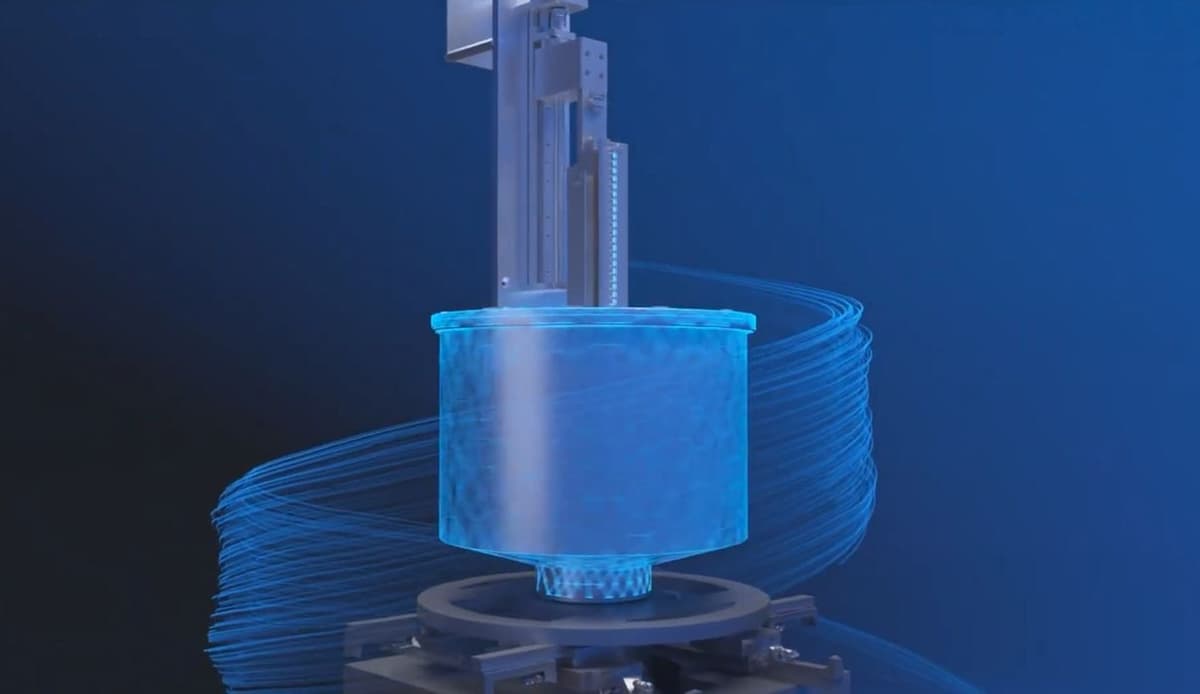
Fugo Precision 3D’s Centrifugal Resin 3D Printing with Integrated Wash and Cure
•February 27, 2026
0
Why It Matters
By collapsing three separate steps into one automated workflow, Fugo’s technology can dramatically cut production time and labor in resin printing, a process traditionally hampered by toxicity and handling complexity.
Key Takeaways
- •Centrifugal tank creates uniform resin layer.
- •Integrated wash, cure, and print in single machine.
- •Prints up to 60 mm/hour, large area per layer.
- •Plastic foil chamber enables easy part removal.
- •Targets industrial market to reduce labor and increase throughput.
Pulse Analysis
Resin stereolithography has long been prized for its fine detail, yet its adoption has been limited by a fragmented workflow that requires separate stations for printing, cleaning and post‑curing. Fugo Precision 3D tackles this bottleneck with a novel centrifugal approach: a rapidly rotating cylindrical tank forms a consistent resin film, while a multi‑laser toolhead cures the material in sync with the spin. This eliminates the static vat used by conventional SLA systems and reduces the risk of resin pooling, delivering more uniform layer exposure and potentially higher part accuracy.
Beyond the core printing cycle, Fugo’s machine automates post‑processing. After a build completes, the uncured resin is drained for reuse, a solvent is introduced and the chamber spins to agitate and clean the parts, then a dedicated UV source finishes curing as the chamber continues to rotate. The innovative plastic‑foil chamber doubles as a removable build platform; once the foil is unfolded, parts detach without mechanical force, streamlining part extraction and minimizing support removal effort. With reported speeds of up to 60 mm per hour across a large cylindrical surface, the system promises a notable boost in throughput compared with traditional desktop SLA printers.
The integrated solution is positioned for the industrial market, where reduced labor, lower material waste, and faster turnaround are critical competitive advantages. If the technology scales reliably, it could reshape resin‑based additive manufacturing by making high‑resolution prints as easy to produce as filament extrusion. Moreover, the concept hints at future desktop adaptations, potentially democratizing advanced resin printing for smaller firms and rapid‑prototyping labs seeking the precision of SLA without the operational overhead.
Fugo Precision 3D’s Centrifugal Resin 3D Printing with Integrated Wash and Cure
0
Comments
Want to join the conversation?
Loading comments...