Key Takeaways
- •Prompt2CAD targets furniture, outputs editable STEP files.
- •Current AI struggles with complex chair geometries.
- •Free trial includes 100 credits, $10/month subscription thereafter.
- •STEP export works in Fusion 360 and other CAD tools.
- •Tool could accelerate 3D‑print workflow if AI improves.
Pulse Analysis
The convergence of generative AI and computer‑aided design is reshaping how manufacturers prototype products. While most text‑to‑3D services produce a single mesh that requires manual cleanup, Prompt2CAD positions itself as a domain‑specific solution for furniture, delivering native STEP files that can be opened directly in professional CAD environments such as Fusion 360 or SolidWorks. By training its model on a curated library of chair, table and sofa geometries, the startup hopes to bypass the generic image‑first workflow and give designers instant, editable building blocks.
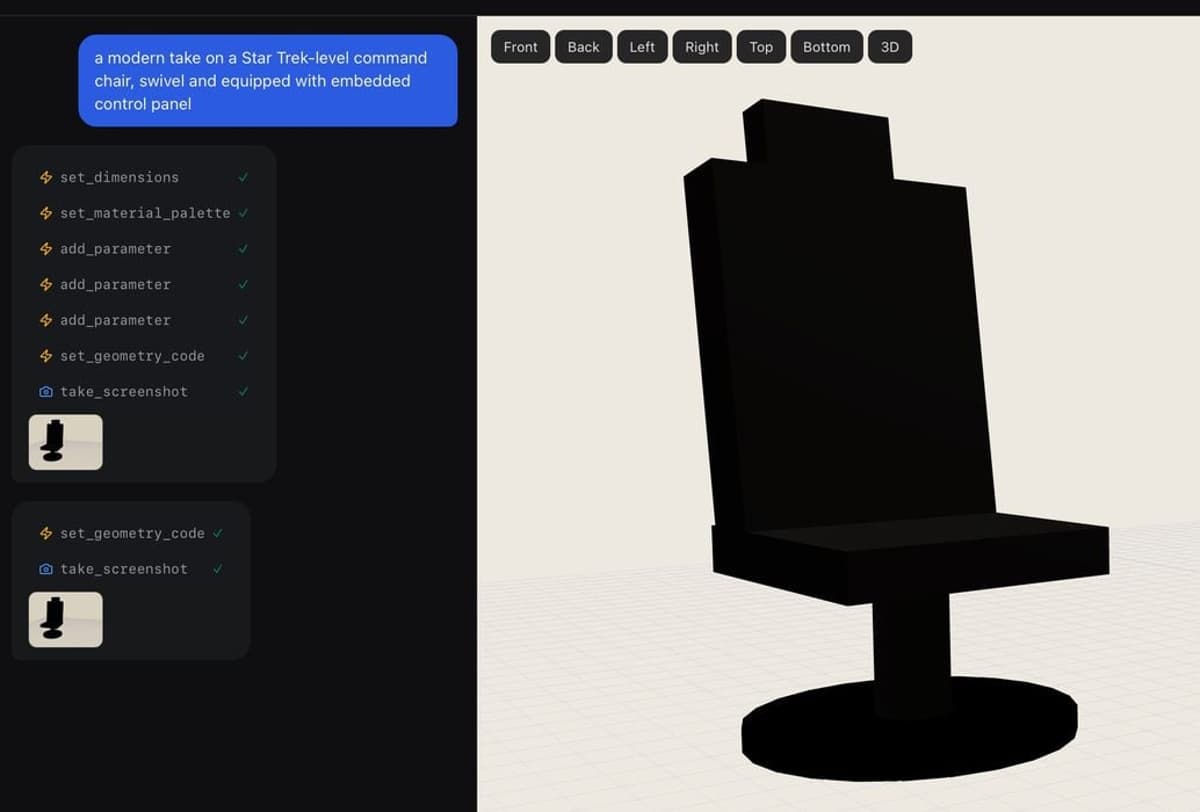
Early user tests, however, reveal a gap between ambition and execution. When prompted for a futuristic command chair, the engine returned a simplistic assembly of five primitives, missing critical features like armrests and control panels. Even after supplying a reference image, the generated model consisted of floating parts that failed to form a coherent chair. This inconsistency underscores a broader challenge for AI‑driven CAD: translating nuanced textual or visual cues into watertight, manufacturable geometry remains a non‑trivial problem that current models have not yet mastered.
If Prompt2CAD can refine its generative core, the implications for the 3‑D‑print and furniture markets are significant. Designers would be able to iterate concepts in minutes, export production‑ready STEP files, and feed them directly into CNC or additive‑manufacturing pipelines, slashing both time‑to‑market and engineering overhead. The service’s pricing—$10 per month after an introductory 100‑credit free trial—makes it accessible to freelancers and small studios, but widespread adoption will hinge on delivering reliable, complex designs. Continued investment in domain‑specific training data and geometry validation could turn this prototype into a mainstream design accelerator.
Hands On with Prompt2CAD
Comments
Want to join the conversation?