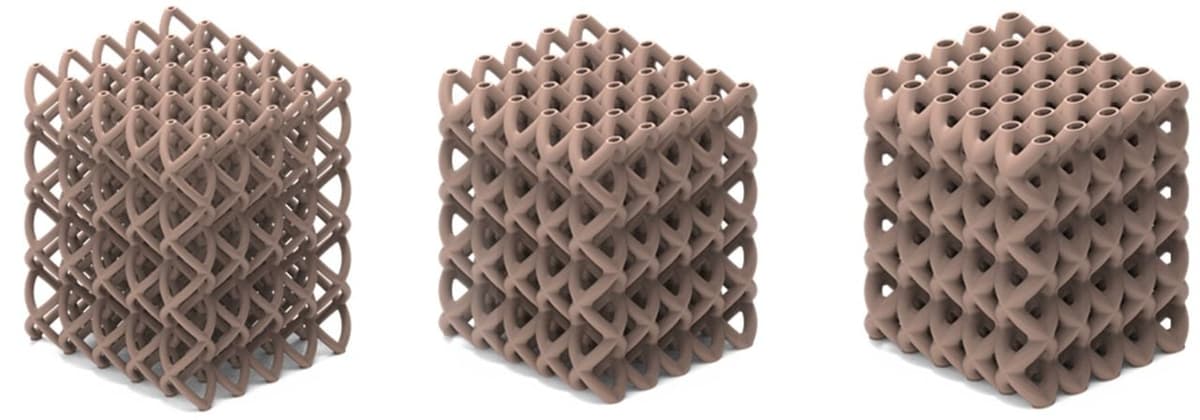
Hollow Spiral Lattice Design Marries Thermal And Mechanical Performance
Key Takeaways
- •Hollow spiral lattice merges structural stiffness with high heat transfer
- •Geometry offers tunable pitch, diameter, wall thickness for co‑optimization
- •Suitable for LPBF metal printing, but powder removal remains challenge
- •Enables single‑part brackets that act as heat sinks, cutting weight
- •Design methodology promotes integrated thermal‑mechanical part design in aerospace
Pulse Analysis
Additive manufacturing has long relied on lattice structures to achieve lightweight strength, yet designers often face a compromise between mechanical rigidity and thermal management. Traditional approaches separate these functions: open‑cell lattices excel at stiffness‑to‑weight ratios, while dedicated micro‑channel heat exchangers maximize surface area for cooling. This split architecture adds part count, introduces interfaces, and increases assembly time—drawbacks that are especially costly in aerospace and high‑performance automotive applications where every gram and millimeter matters.
The hollow spiral lattice redefines that trade‑off by embedding helical channels within a load‑bearing scaffold. By adjusting spiral pitch, channel diameter, wall thickness and unit orientation, engineers can dial in specific relative densities, elastic moduli and convective heat‑transfer coefficients. The continuous geometry also mitigates anisotropy and pressure‑drop issues that plagued earlier TPMS‑based hybrids. While the design aligns naturally with laser powder‑bed fusion of metals, practical considerations such as powder evacuation from enclosed channels and overhang support still require careful build‑orientation strategies. Nonetheless, the concept’s parametric nature fits seamlessly into modern CAD and topology‑optimization tools, accelerating the transition from concept to printable model.
Industry impact could be profound. A single printed component that serves as both a structural bracket and an integrated heat sink eliminates fasteners, O‑rings and thermal‑interface materials, delivering weight savings and reliability improvements. Potential applications span from turbine‑engine mounts with internal coolant flow to drone motor housings that dissipate heat without external fans. As design software incorporates the hollow‑spiral library and post‑processing solutions mature, manufacturers are likely to adopt this multifunctional lattice for next‑generation lightweight, thermally‑aware systems, reinforcing the shift toward truly integrated additive‑manufacturing part design.
Hollow Spiral Lattice Design Marries Thermal And Mechanical Performance
Comments
Want to join the conversation?