How Digital Image Correlation Is Improving 3D Printed Polymers
Key Takeaways
- •DIC provides full‑field strain maps for 3D‑printed polymer fracture tests
- •Speckle‑pattern cameras replace strain gauges, reducing setup time and labor
- •Orientation, raster angle, and layer thickness appear directly in DIC strain fields
- •Standardizing DIC parameters is needed for reproducible fracture data across labs
Pulse Analysis
Additive manufacturing has opened new design spaces for polymer components, but the layer‑by‑layer process introduces anisotropy, porosity, and cure gradients that complicate mechanical certification. Traditional fracture testing relies on point measurements such as strain gauges, which often miss the nuanced stress concentrations at interlayer interfaces. As aerospace, automotive, and medical sectors move toward volume production of printed parts, engineers need reliable methods to pinpoint crack initiation and growth under realistic service loads. This demand drives the search for full‑field measurement techniques that can capture the heterogeneous behavior of printed polymers.
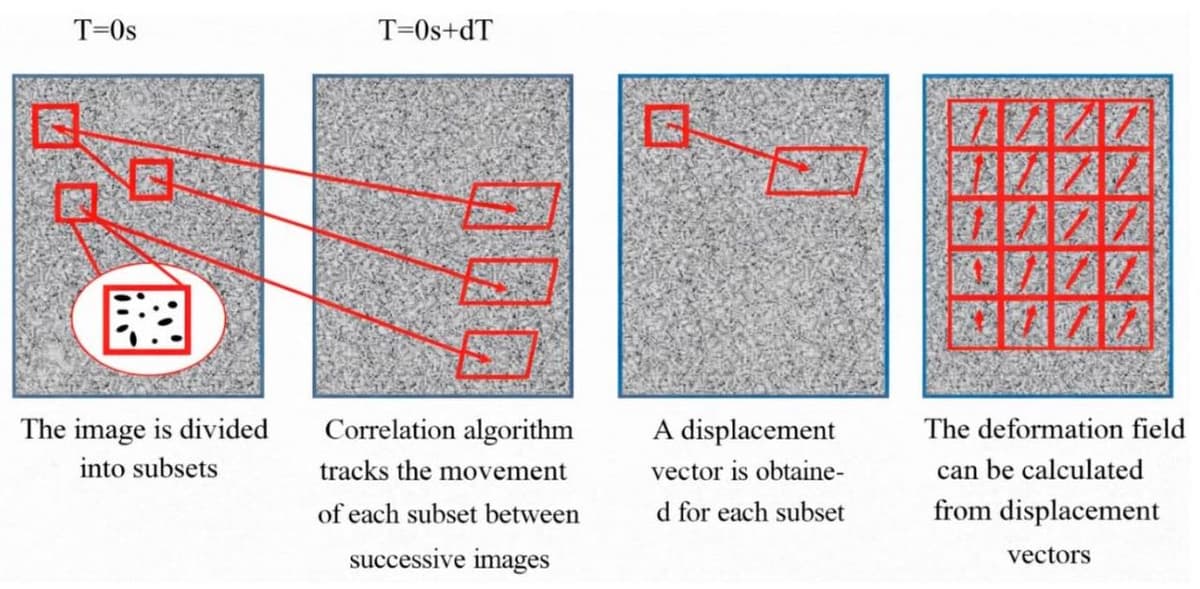
Digital Image Correlation meets that need by projecting a random speckle pattern onto the specimen and tracking pixel displacements with calibrated cameras. The resulting displacement field is converted into high‑resolution strain maps, revealing crack tip opening displacement, stress intensity factors, and J‑integral values without physical contact. Recent advances in affordable high‑speed cameras and robust software have lowered the barrier to entry, allowing laboratories to replace or augment conventional gauges with DIC setups that generate richer datasets from a single test. The technique also simplifies out‑of‑plane correction for slender coupons.
Despite its promise, widespread adoption hinges on standardizing speckle quality, subset size, and lighting conditions to ensure repeatable results across facilities. Current literature focuses on room‑temperature, monotonic loading of small coupons, leaving fatigue, elevated temperature, and environmental exposure largely unexplored. As standards bodies begin to incorporate DIC guidelines, manufacturers can expect faster qualification cycles and higher confidence in part durability, ultimately reducing warranty costs and accelerating market entry. Continued research into automated DIC pipelines and integration with machine‑learning defect detection will further embed the technology into the additive‑manufacturing workflow.
How Digital Image Correlation is Improving 3D Printed Polymers
Comments
Want to join the conversation?