Key Takeaways
- •Inkjet prints electrodes directly on polymer 3D prints
- •Digital design changes replace physical tooling for each iteration
- •Process reduces material waste compared with screen or aerosol‑jet printing
- •Curing step determines final conductivity and adds production time
- •Service bureaus could offer hybrid prints as a value‑added service
Pulse Analysis
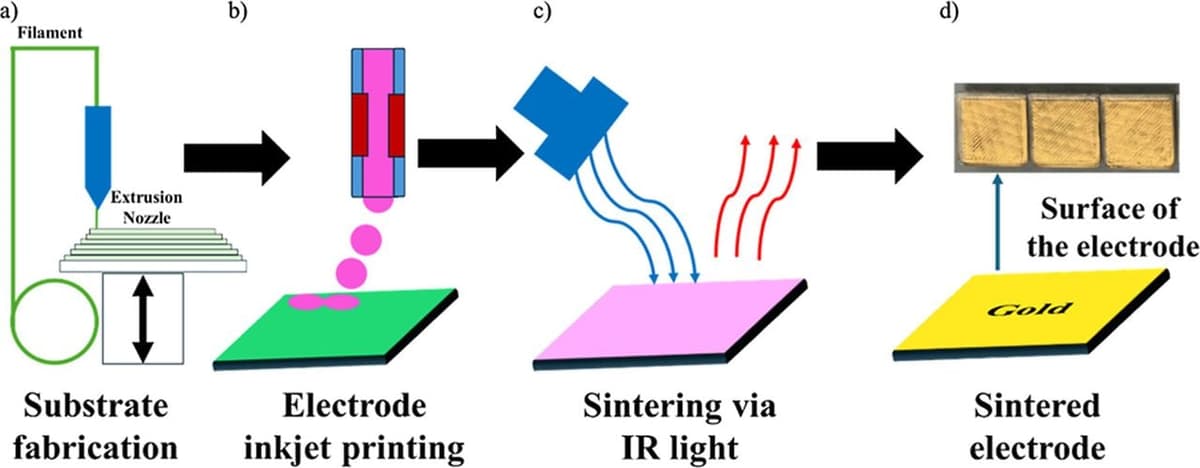
Printed electronics have moved beyond flat copper traces, seeking curved and bespoke form factors that traditional PCBs cannot provide. Additive manufacturing supplies that geometric freedom, but integrating functional circuitry has remained a bottleneck. The hybrid inkjet‑on‑3D‑print approach bridges this gap, allowing high‑resolution conductive patterns to be deposited on virtually any polymer surface without masks, aligning the digital design workflow of electronics with the flexibility of modern 3D printers.
The process begins with a fused‑filament or similar polymer print, whose surface is pre‑treated to mitigate ridges and porosity. An inkjet head then deposits microliter droplets of silver‑based or carbon‑based conductive ink in precise, CAD‑driven patterns. After deposition, a thermal, photonic or chemical curing step sinters the particles, achieving the target conductivity. Compared with aerosol‑jet or screen printing, inkjet reduces material waste and eliminates costly stencils, though it introduces new variables such as ink viscosity, nozzle clogging, and the time required for post‑print sintering. These factors will shape the economics of scaling the method beyond prototyping.
For laboratories, startups, and 3D‑print service bureaus, the hybrid workflow offers a rapid path from concept to functional device—think custom flow‑cell lids, wearable sensor housings, or microfluidic fixtures—without investing in dedicated tooling. While ink costs and cure times remain constraints, the ability to iterate designs by swapping a file rather than re‑tooling could accelerate innovation cycles across sectors ranging from biotech to IoT hardware. As ink formulations improve and automated curing solutions emerge, the technology is poised to become a mainstream offering in the additive manufacturing ecosystem.
Hybrid Inkjet Electrodes On 3D Printed Parts
Comments
Want to join the conversation?