Key Takeaways
- •GE/Concept Laser patents real‑time laser beam modulation for metal PBF.
- •Modulation device can adjust beam shape, phase, amplitude, polarization on‑fly.
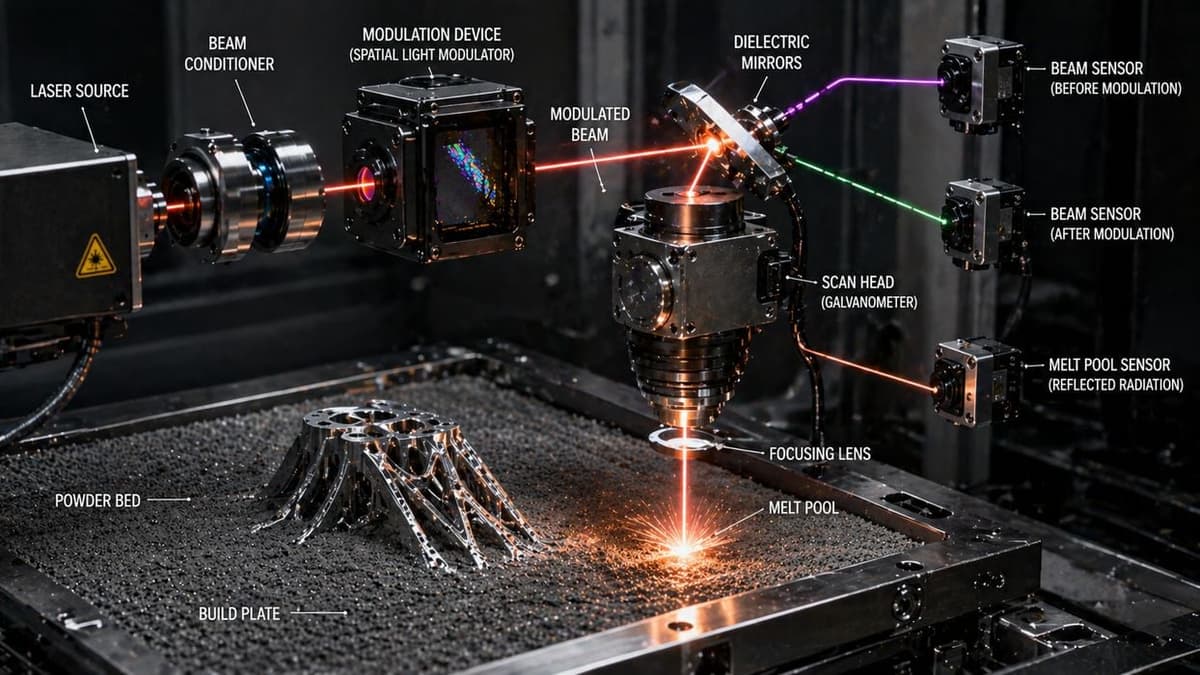
- •Integrated sensors monitor pre‑ and post‑modulation beam and melt‑pool reflections.
- •Dynamic control aims to improve part consistency and microstructure quality.
- •Success could reduce failed builds in aerospace, medical and energy sectors.
Pulse Analysis
Metal powder‑bed fusion has become a cornerstone of additive manufacturing, yet its reliance on static optical setups makes it vulnerable to fluctuations in powder behavior, part geometry and machine drift. Operators traditionally adjust power, scan speed and hatch spacing, but those changes are often reactive, based on post‑process analysis rather than instantaneous feedback. As demand for high‑integrity components grows—particularly in aerospace, medical implants and energy equipment—manufacturers are seeking closed‑loop solutions that can monitor and correct the melt‑pool in real time, turning a largely observational process into an actively controlled one.
The newly filed GE/Concept Laser patent outlines a sophisticated approach: a downstream spatial‑light modulator—such as a liquid‑crystal‑on‑silicon or digital micromirror device—dynamically reshapes the laser beam’s amplitude, phase and polarization. Parallel sensor arrays capture the beam before modulation, after modulation, and the reflected radiation from the build plane, feeding a controller that instantly tweaks laser parameters to meet predefined temperature and melt‑pool geometry targets. This capability could enable on‑the‑fly transitions between Gaussian, top‑hat or multi‑spot profiles, offering unprecedented control over energy distribution and potentially allowing microstructural tailoring during a single build.
If the concept proves viable, it could shift the economics of metal AM by reducing failed builds, shortening qualification cycles, and expanding the material portfolio for critical applications. However, challenges remain, including achieving the sub‑millisecond response times required for high‑speed scan paths and integrating the technology into existing multi‑laser platforms without compromising throughput. Successful commercialization would likely accelerate adoption of metal AM in regulated industries, where consistent quality and traceability are paramount, and could set a new benchmark for intelligent, adaptive manufacturing systems.
Laser Beam Modulation Patent Targets Smarter Metal PBF
Comments
Want to join the conversation?