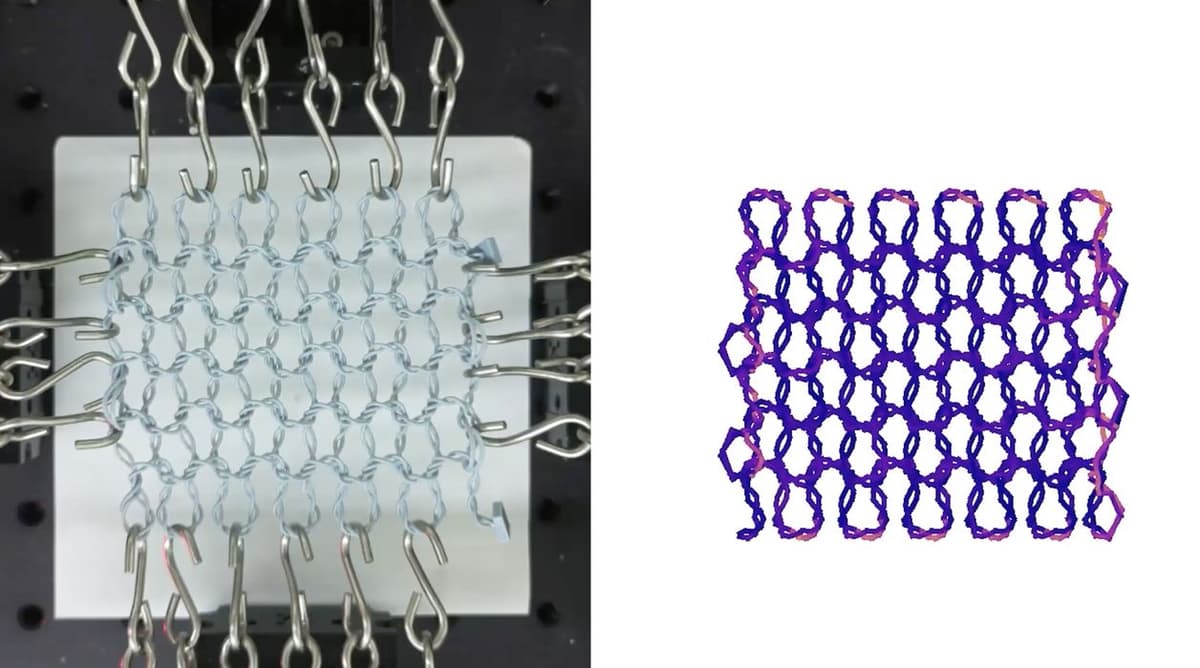
Multiscale 3D-Printed Knits Show Tunable Mechanics
Key Takeaways
- •Printed knits achieve strain stiffening through loop entanglement
- •Loop size, crossing angle, and density tune mechanical response
- •Fabrication hurdles include resin removal, surface finish, and support removal
- •Applications span helmet liners, shoe midsoles, prosthetic sockets, and grippers
- •Design software must incorporate frictional contact for accurate predictions
Pulse Analysis
Additive manufacturing has moved beyond rigid lattices toward textile‑inspired architectures that mimic the comfort and adaptability of fabrics. Recent advances in photopolymer and powder‑based printing now enable the creation of intricate looped structures, allowing engineers to embed mechanical functions directly into geometry. This shift mirrors trends in soft robotics and wearable technology, where compliance and impact mitigation are paramount, and it leverages the inherent advantages of 3‑D printing—customization, rapid iteration, and material efficiency.
The core innovation lies in exploiting entanglement: loops slide, rotate, and lock under strain, producing a nonlinear response that can be programmed through design parameters. By nesting motifs at yarn, stitch, and fabric scales, designers can orchestrate a cascade of behaviors—initial cushioning followed by progressive stiffening, or the reverse. However, achieving reliable performance demands precise control over feature resolution, surface texture, and post‑process cleaning, as any variation can alter frictional contact and thus the mechanical outcome. Current printing platforms must balance resolution with throughput, and new support‑removal strategies are essential for dense, interlocked geometries.
If these challenges are addressed, the market impact could be substantial. Industries ranging from sports equipment to prosthetics could replace multi‑material assemblies with a single printable polymer that adapts on demand, lowering part counts and inventory complexity. Moreover, simulation tools will need to evolve beyond beam‑based topology optimization to incorporate contact mechanics and path‑dependent friction models. Such capability will accelerate adoption, enabling designers to predict fatigue life, energy dissipation, and environmental sensitivity, ultimately delivering smarter, lighter, and more resilient products.
Multiscale 3D-Printed Knits Show Tunable Mechanics
Comments
Want to join the conversation?