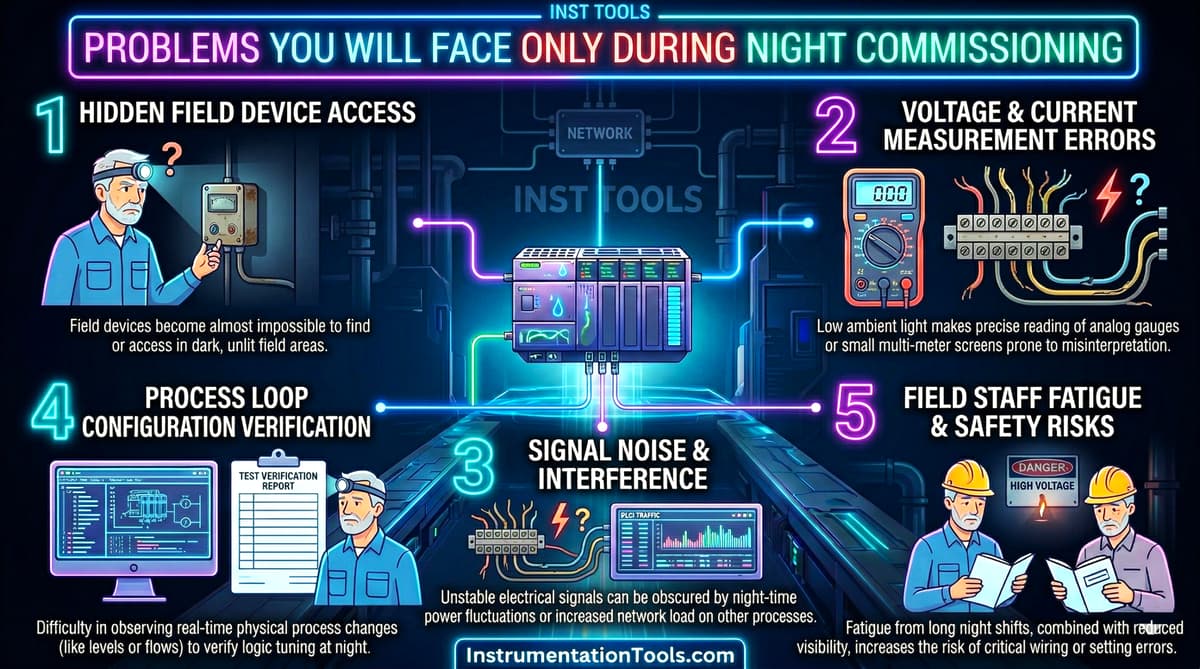
Problems You Will Face Only During Night Commissioning
Key Takeaways
- •Technical support scarce at night, delays fault resolution.
- •Dim lighting causes wiring and sensor misalignments.
- •Power fluctuations and utility switches mimic PLC faults.
- •Fatigue leads to logic errors and missed safety steps.
- •Coordinating with IT and maintenance crews prevents delays.
Pulse Analysis
Many plants schedule commissioning after hours to avoid production interruptions, but the quiet environment masks a range of hidden hazards. While daytime teams benefit from immediate OEM assistance, full‑staffed IT desks, and abundant natural light, night crews operate with a lean support structure. This disparity forces engineers to rely heavily on personal expertise and documentation, often stretching simple diagnostics into hours of isolated problem‑solving. The reduced visibility also makes subtle wiring errors—such as reversed 4‑20 mA loops or loose terminal screws—far harder to spot, leading to downstream logic faults that can stall an entire start‑up sequence.
Utility stability becomes a critical variable after dark. Plants frequently shift loads, switch feeders, or run on alternate transformers at night, causing voltage sags and transient disturbances that mimic PLC or VFD errors. Simultaneously, scheduled server patches, backups, and cybersecurity updates can interrupt Ethernet/IP communication, leaving engineers scrambling to differentiate between genuine automation issues and routine IT maintenance. Coupled with a skeleton mechanical crew, these factors compound delays, as the right specialist may not be on‑site to resolve a motor jam or valve misalignment promptly. The cumulative effect is a longer commissioning timeline and increased pressure on the automation team.
Mitigating night‑shift risks requires proactive planning and disciplined execution. Organizations should establish clear escalation paths with OEM support, pre‑validate utility conditions, and synchronize commissioning windows with IT change‑management calendars. Implementing robust checklists, double‑checking logic entries, and enforcing strict lockout‑tagout procedures can counteract fatigue‑induced errors. Moreover, rotating crew schedules to ensure fresh eyes during critical phases and leveraging remote monitoring tools can restore some of the daytime support advantages. By addressing these night‑only challenges, plants can achieve smoother, safer, and more cost‑effective commissioning outcomes.
Problems You Will Face Only During Night Commissioning
Comments
Want to join the conversation?