Researchers 3D Print Cubic Microbubbles With Ultra-High Aspect Ratios
Key Takeaways
- •Cubic microbubbles printed with walls thinner than a human hair
- •Two‑photon polymerization enables sub‑micron sealed cavities
- •Design expands micro‑acoustic resonators beyond spherical geometries
- •Potential uses include microreactors, valves, and tunable ultrasound filters
- •Throughput remains a bottleneck for large‑scale production
Pulse Analysis
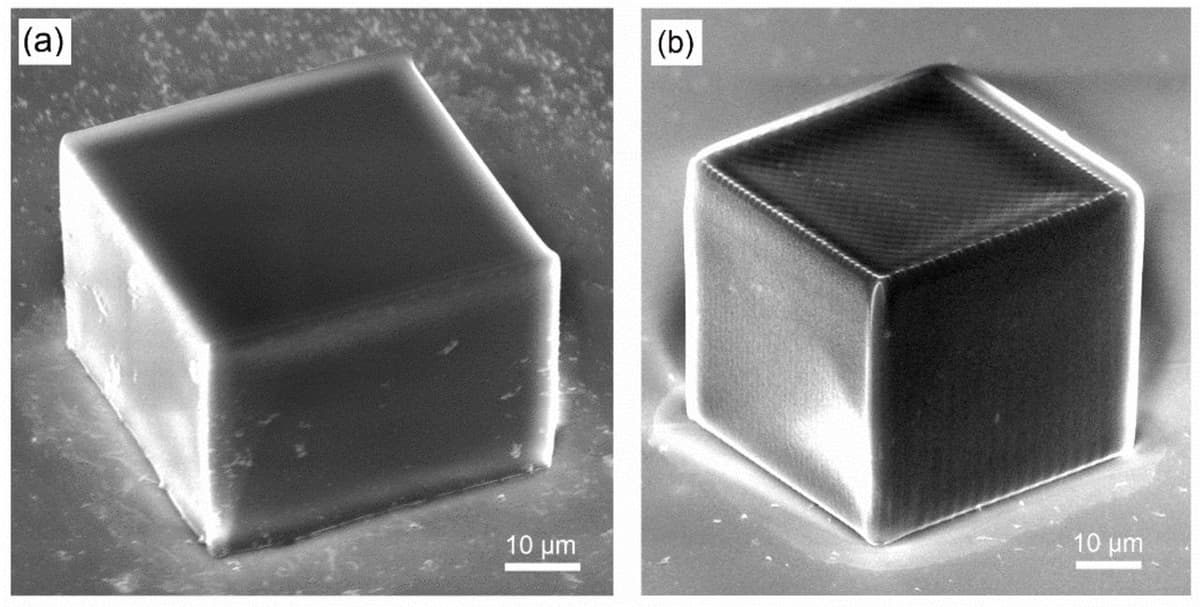
The ability to fabricate enclosed voids at the microscale has long eluded additive manufacturing. Conventional microbubble production relies on fluidic emulsification, yielding spherical shells that are easy to fill and seal. Two‑photon polymerization, a laser‑based direct‑write technique, can sculpt features smaller than a micron inside a photopolymer, but removing uncured resin from a closed cavity without damaging thin walls is notoriously difficult. The new method reported by the research team fine‑tunes exposure dose, scan strategy, and post‑processing to evacuate resin while preserving ultra‑thin roofs, effectively creating ‘cubic bubbles’ that were previously considered impractical.
These square‑shaped microcavities open fresh avenues across several high‑tech sectors. In acoustic engineering, non‑spherical resonators can achieve higher quality factors and tunable frequency responses, improving ultrasound imaging and targeted drug‑delivery platforms. Microfluidic designers can embed sealed chambers as on‑chip storage pods, pressure‑actuated valves, or reaction vessels, enabling more compact lab‑on‑a‑chip systems. Metamaterial researchers may arrange arrays of cubic bubbles to tailor acoustic impedance or refractive index in ways spherical pores cannot, potentially leading to lightweight sound‑absorbing panels or novel optical components.
Despite the promise, scaling the process to industrial volumes remains a challenge. Two‑photon polymerization is intrinsically serial, with scan speeds measured in millimeters per second, making the fabrication of millions of microbubbles time‑consuming. Moreover, the photopolymers compatible with 2PP often lack the thermal, chemical, or biocompatibility specifications required for commercial devices. Future work will likely focus on multi‑beam parallelization, automated vent‑sealing routines, and the development of robust resin formulations. If these hurdles are cleared, cubic microbubbles could become a standard component in next‑generation micro‑acoustic and microfluidic architectures.
Researchers 3D Print Cubic Microbubbles With Ultra-High Aspect Ratios
Comments
Want to join the conversation?