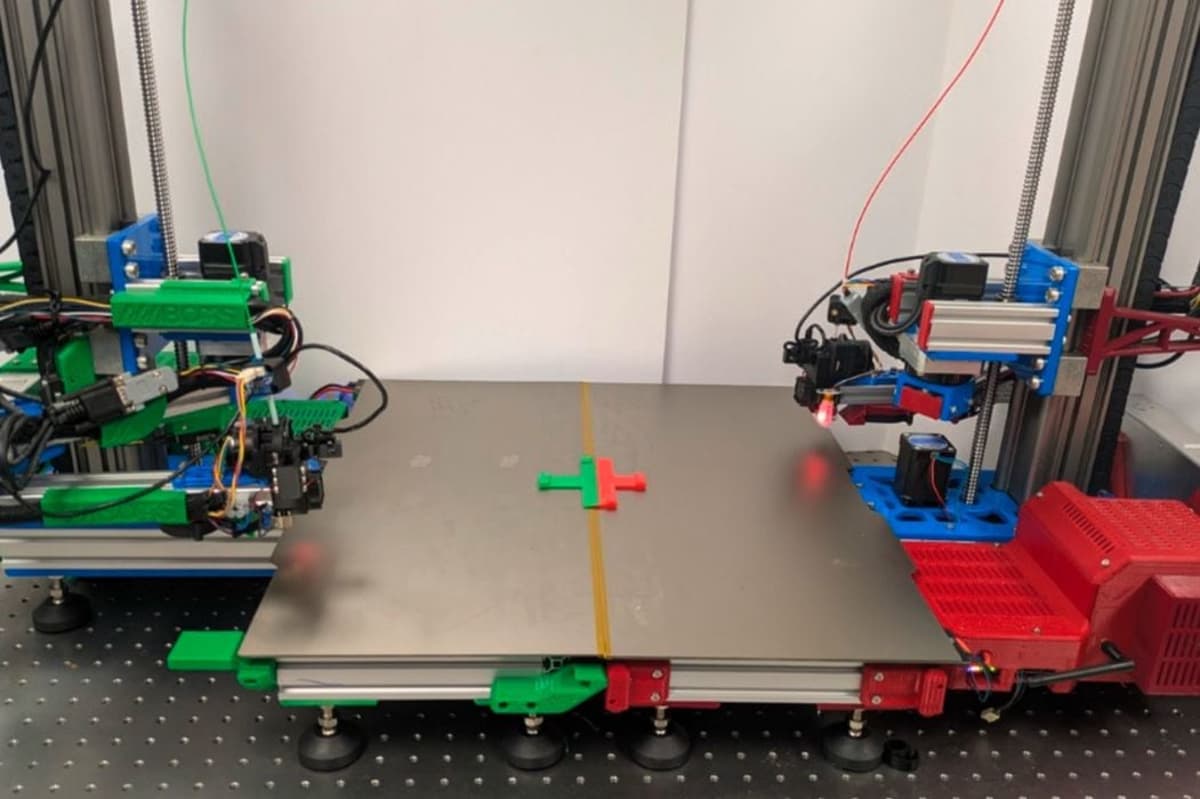
Researchers Automate Calibration For 3D Printer Swarms
Key Takeaways
- •Automatic calibration aligns multiple printers within sub‑millimeter tolerance
- •Reduces setup time from hours to minutes for swarm printing
- •Enables larger build volumes without investing in single massive printers
- •Improves reliability; failed robot can be bypassed while others continue
Pulse Analysis
Cooperative 3D printing, often called C3DP, has long been touted as a way to multiply throughput and expand build envelopes by dividing a part among several machines. The primary obstacle has been precise alignment: each printer’s nozzle must share an identical X, Y, and Z reference, otherwise seams appear as gaps or weak joints. The new automated calibration loop leverages each robot’s built‑in sensors to estimate its pose relative to a common reference frame, then iteratively refines that estimate until inter‑printer stitch errors fall below a tight tolerance. By eliminating manual probing rigs and external motion‑capture systems, the process slashes setup time and reduces human error.
Beyond speed, the calibration workflow adds robustness to large‑format additive manufacturing. In traditional single‑gantry systems, a hardware failure halts the entire build. With a calibrated swarm, a malfunctioning printer can be isolated while the remaining units continue, preserving productivity and reducing downtime. Moreover, the ability to re‑calibrate mid‑print compensates for thermal drift or platform deflection, issues that previously limited the length of continuous prints. This dynamic adjustment opens the door for longer, more complex parts that were previously impractical on a single machine.
The commercial implications are significant. Companies can now achieve the effective build volume of a massive printer by orchestrating a fleet of smaller, lower‑cost units, lowering capital expenditure and simplifying maintenance. As the technology matures, we can expect software ecosystems that manage printer allocation, error monitoring, and real‑time calibration as a service. This shift could accelerate adoption of additive manufacturing in aerospace, automotive, and tooling sectors where large, high‑precision components are in demand, positioning automated calibration as a cornerstone of the next generation of 3D printing infrastructure.
Researchers Automate Calibration For 3D Printer Swarms
Comments
Want to join the conversation?