Rotational 3D Printing Can Create Programmable Shape Morphing Lattices
Key Takeaways
- •Rotational extrusion embeds helical active-passive interfaces in each filament.
- •Programmable bending and twisting achieved by controlling nozzle rotation speed.
- •Method works with DIW multi‑material printing, limiting material palette.
- •Print speed slows due to rotation and multi‑channel deposition.
- •Applications include soft‑robotic grippers, deployable medical scaffolds, compact devices.
Pulse Analysis
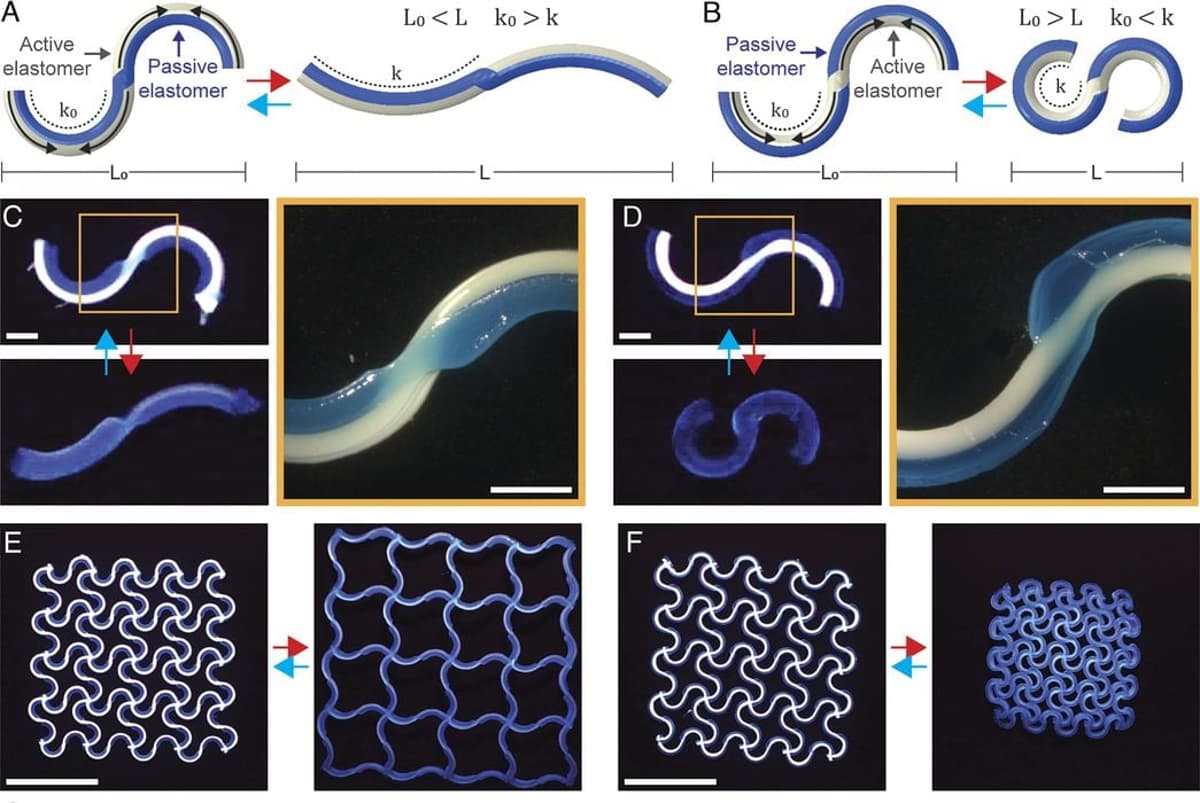
The 4D‑printing field has long been constrained by bilayer or planar hinge designs that only bend in a single direction. Traditional multi‑material extrusion can place active and passive regions side‑by‑side, but without control over the internal angle of anisotropy, designers are limited to simple curls. The new rotational extrusion technique leverages a helical arrangement of active‑passive inks, turning each filament into a miniature actuator capable of coupled bending and torsion. This hardware‑driven approach sidesteps the need for specialized photopolymers or optical patterning, broadening the toolbox for engineers seeking true three‑dimensional shape change.
Mechanically, the system mimics a bimetal strip: differential strain between bonded phases generates curvature, while the helical orientation adds twist. By varying rotation rate, filament diameter, and phase placement, the researchers demonstrated lattices that deploy, curl, and lock into predefined geometries on demand. The process is currently limited to direct‑ink‑writing platforms, restricting material choices to inks that can be co‑extruded and cured in situ. Moreover, the added rotation and multi‑channel deposition slow throughput, and existing slicers lack native support for synchronized nozzle rotation, requiring bespoke software pipelines.
Despite these hurdles, the technology holds promise for sectors where compact storage and on‑site activation are critical. Soft‑robotic grippers could exploit lattice‑scale actuators for adaptive grasping, while biomedical devices such as stents or tissue scaffolds might benefit from gentle, solvent‑driven shape changes. Consumer products that need to unfold or reconfigure after shipping—wearables, packaging, or deployable structures—could also leverage this capability to reduce part counts and assembly labor. As software integration improves and material libraries expand, rotational 3D printing may become a cornerstone of next‑generation manufacturing, turning filaments into programmable, functional components rather than static structural elements.
Rotational 3D Printing Can Create Programmable Shape Morphing Lattices
Comments
Want to join the conversation?