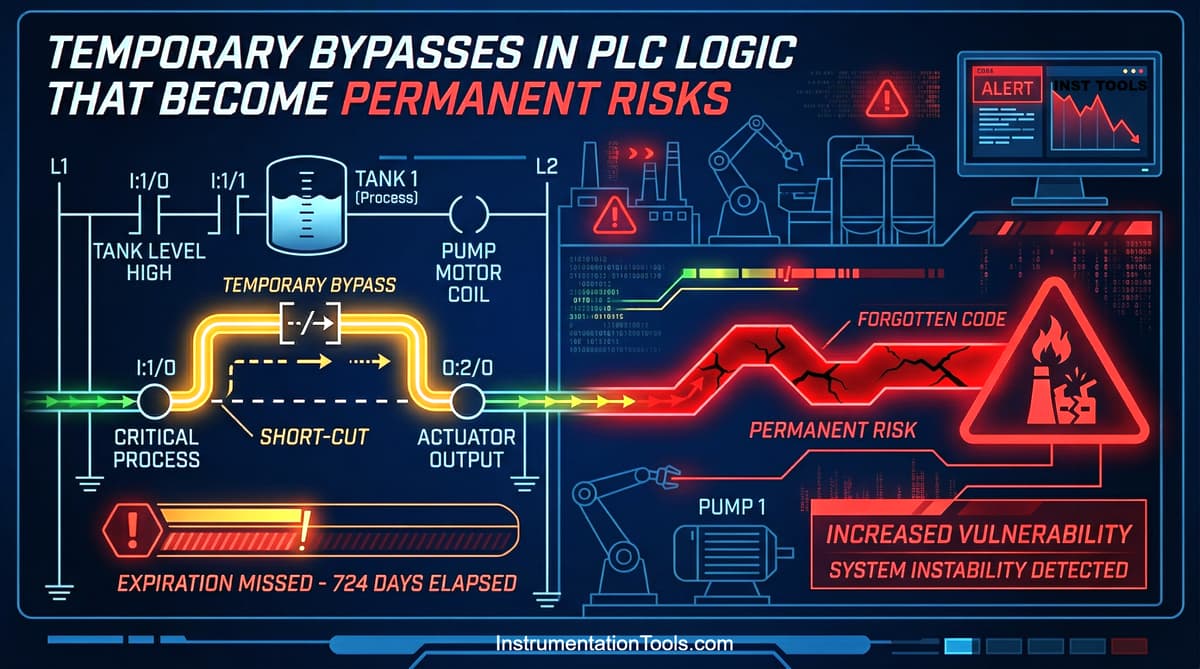
Temporary Bypasses in PLC Logic That Become Permanent Risks
Key Takeaways
- •Forcing inputs without removal silently disables critical interlocks.
- •Hard‑coded permissives bypass real sensor health checks.
- •Unremoved alarm suppression hides early fault warnings from operators.
- •Permanent maintenance mode weakens layered safety defenses during production.
- •Undocumented jump logic increases control complexity and troubleshooting risk.
Pulse Analysis
Industrial automation projects routinely encounter short‑term work‑arounds—forced inputs, temporary interlock masks, or ad‑hoc jump rungs—because production pressure leaves little time for full engineering fixes. While such bypasses keep a plant humming, they are often entered directly into the PLC program without a formal change request or traceability. Over weeks, months, or even years the temporary code can blend into the baseline logic, eroding the safety integrity level (SIL) that standards like IEC 61511 demand. The hidden nature of these edits makes compliance audits and risk assessments increasingly difficult.
Common patterns include forcing an input to ON and never clearing it, hard‑coding a permissive to TRUE, suppressing alarms indefinitely, and leaving maintenance mode active. Each of these shortcuts removes a layer of protection that the original control philosophy relied on. A forced level switch, for example, will ignore a genuine low‑level condition, allowing pumps to run dry and potentially damaging equipment. Similarly, permanent alarm masking can let a slowly degrading valve go unnoticed until a catastrophic failure occurs, turning a minor fault into a major safety incident.
Mitigating these hidden risks requires disciplined change management: every temporary edit must be logged, reviewed, and scheduled for removal before the next production shift. Automated tools that compare live PLC code against a version‑controlled baseline can flag forced inputs, hard‑coded constants, and lingering maintenance flags. Regular safety‑integrity audits, coupled with operator training on the dangers of prolonged bypasses, reinforce a culture where short‑term fixes are treated as tickets, not permanent solutions. Organizations that institutionalize such practices not only protect personnel but also avoid costly downtime and regulatory penalties.
Temporary Bypasses in PLC Logic That Become Permanent Risks
Comments
Want to join the conversation?