Key Takeaways
- •WIM triples WAAM build endurance, reaching 50‑60 layers.
- •Adaptive loop scans each n layers, adjusts speed and feed parameters.
- •Database logs ~1 million rows across 197 experiments for traceability.
- •Vendor‑neutral schema links sensor data to real‑time path planning.
- •Future work targets ML, PID control, and higher‑frequency streams.
Pulse Analysis
Wire Arc Additive Manufacturing (WAAM) offers rapid metal deposition, yet its sensitivity to layer‑height drift and steep geometries has limited industrial adoption. Existing standards such as DNV‑ST‑B203 and ISO/ASTM 52943‑2 prescribe what data to record, but they stop short of providing a unified, system‑agnostic framework to act on that data during production. The WAAM Information Model (WIM) fills this void by defining a hierarchical, SQL‑based schema that captures every motion command, welding parameter, and sensor frame, creating a single source of truth that can be queried in real time.
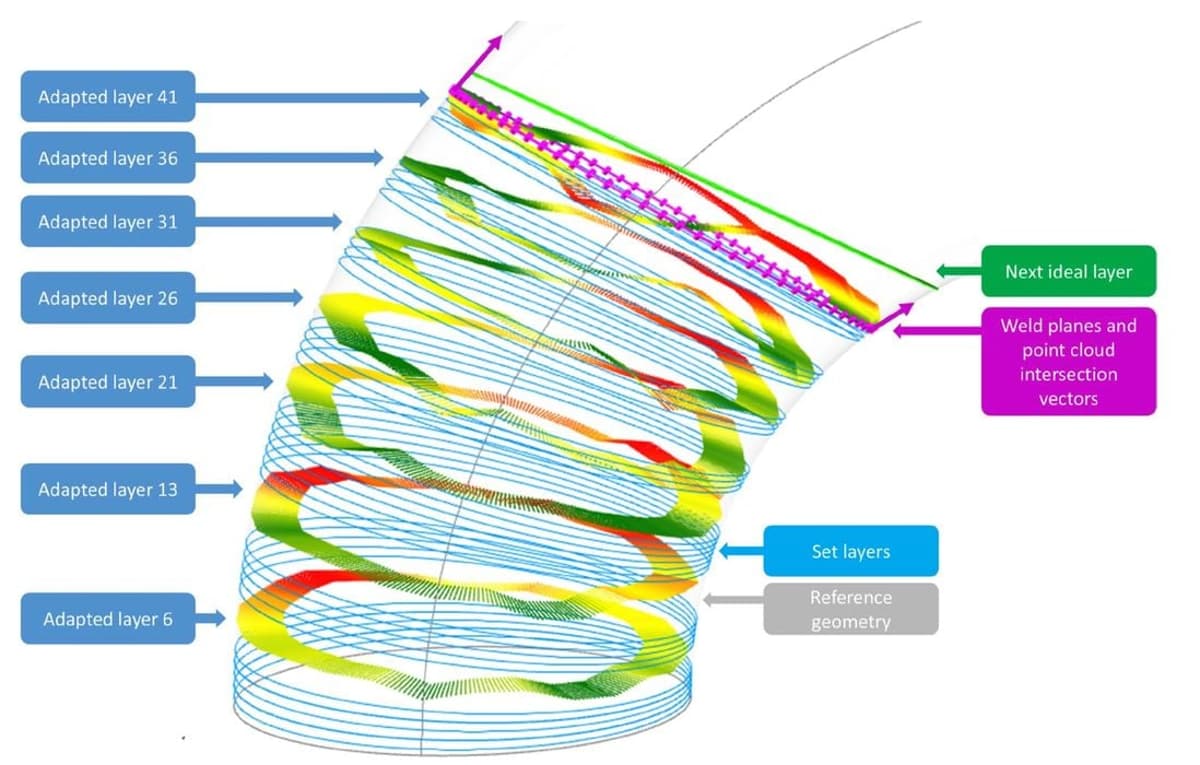
In the RWTH Aachen demonstration, the WIM‑enabled loop performed a one‑minute laser scan after each set of layers, compared the measured geometry to an ideal model, and automatically retuned robot speed, wire‑feed rate, and arc length before the next pass. This intermittent adaptation proved decisive: static‑parameter builds collapsed around the 15th layer due to torch collisions, whereas the adaptive runs sustained 50‑60 layers, effectively tripling usable build length. The system logged roughly one million rows of robot, welder, and thermal data across 197 experiments, providing a granular digital thread that surpasses the closed‑stack monitoring solutions offered by MX3D, RAMLAB, and others.
The broader impact lies in compliance and scalability. Auditors increasingly demand traceable links from command to outcome, not just video logs, and WIM delivers that linkage while remaining vendor‑neutral. Future enhancements—machine‑learning clustering of parameter sets, PID‑style controllers, and read‑only LLM interfaces for natural‑language queries—promise tighter closed‑loop control and faster scan cycles. Extending the model to higher‑frequency data streams and to alloys beyond mild steel will be critical for moving WAAM from research labs to high‑volume production lines.
WIM Enables Traceable, Adaptive WAAM
Comments
Want to join the conversation?