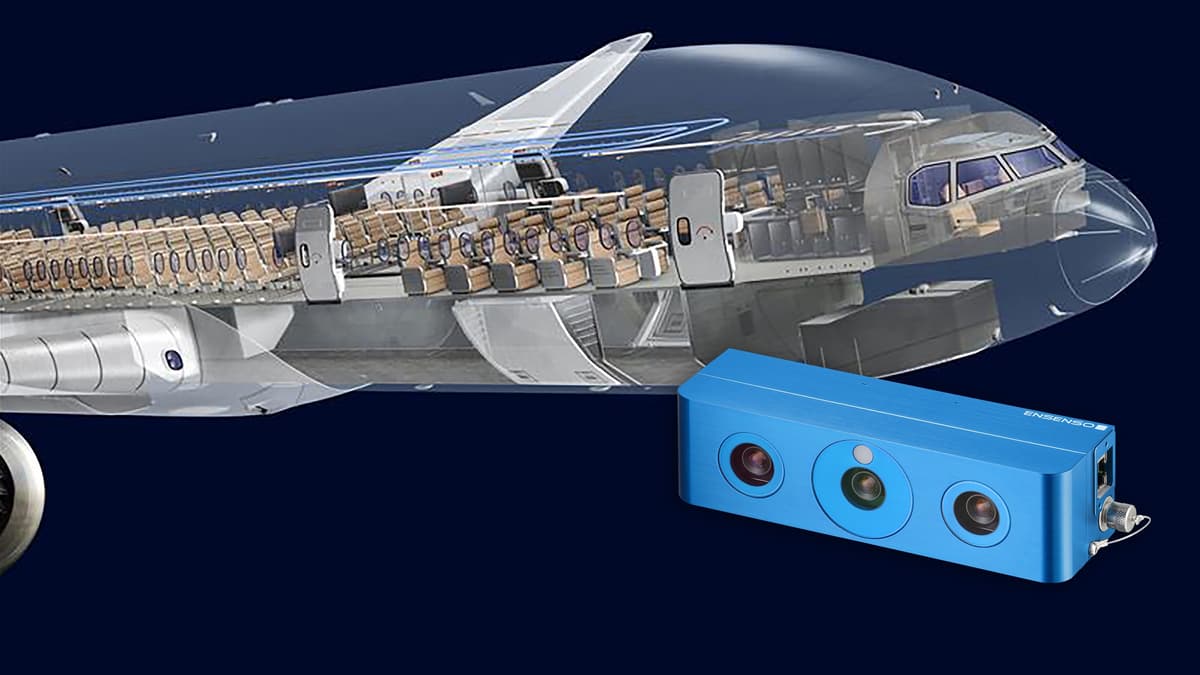
3D Vision Meets the Digital Thread in Next-Gen Aircraft Assembly
Why It Matters
By merging 3‑D vision, robotics and a secure data backbone, DLR accelerates aircraft cabin production while raising accuracy, a competitive edge in an industry where safety and cost efficiency are paramount.
Key Takeaways
- •Ensenso N36 3D camera aligns drilling positions via point‑cloud matching.
- •Autonomous mobile robot achieves ~5 mm positioning accuracy for aircraft frames.
- •Digital thread links CAD design directly to production planning, reducing lead time.
- •MES uses OPC UA to securely coordinate camera, robot, and control systems.
- •Process cuts manual measurement, boosts precision and traceability in cabin assembly.
Pulse Analysis
The aerospace sector is increasingly embracing a "digital thread" that stitches together design intent and shop‑floor execution. In DLR’s DiCADeMA project, every cabin‑layout change—whether seat spacing or luggage compartment geometry—is instantly reflected in production plans, allowing engineers to run virtual simulations before any metal is cut. This seamless data flow reduces costly re‑work and shortens the time from concept to first‑article, a critical advantage as airlines demand faster model rollouts and tighter margins.
At the heart of the system is the IDS Ensenso N36 camera, which generates dense three‑dimensional point clouds and matches them against the aircraft’s CAD model. Using hand‑eye calibration and iterative minimisation, the camera calculates correction vectors that the robot arm applies to mark precise drilling locations. Communication relies on the OPC UA protocol, a widely adopted standard that ensures secure, real‑time data exchange between the camera, robot, and the Manufacturing Execution System. The autonomous mobile robot’s 5 mm positioning accuracy and the camera’s short working distance together deliver the repeatability required for high‑volume cabin assembly.
Beyond aerospace, the technology stack—compact 3‑D vision, OPC UA‑enabled MES, and mobile robotics—offers a template for any industry where complex, low‑tolerance assemblies are common, such as automotive, shipbuilding, or wind‑turbine manufacturing. By automating the measurement‑to‑action loop, manufacturers can free skilled workers for higher‑value tasks, improve traceability for regulatory compliance, and ultimately lower production costs. As the algorithms for point‑cloud alignment mature, we can expect even tighter tolerances and broader adoption of fully digital, networked factories.
3D Vision Meets the Digital Thread in Next-Gen Aircraft Assembly
Comments
Want to join the conversation?
Loading comments...