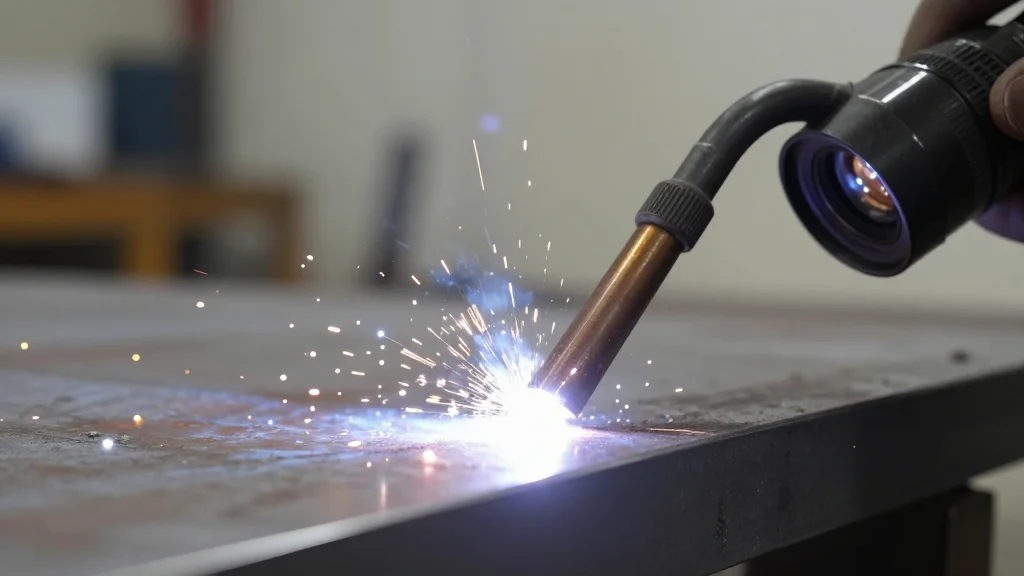
A Spatter-Aware, Data-Driven Closed-Loop Framework for Real-Time Monitoring and Adaptive Control in Wire Arc Additive Manufacturing
Why It Matters
Real‑time spatter monitoring and adaptive control directly improve WAAM stability, reducing scrap and downtime while enabling scalable industrial deployment. The framework demonstrates a practical path to consistent additive‑manufacturing quality without expensive hardware upgrades.
Key Takeaways
- •YOLOv11 with CBAM and CIoU reaches 94.5% mAP@0.5
- •Real-time inference runs at 138 FPS on 640×640 images
- •Precision 92% and recall 89% yield F1 score of 0.90
- •Random forest suggests micro‑adjustments to current and voltage
- •Interactive UI visualizes spatter trends, parameters, and layer quality heatmaps
Pulse Analysis
Wire Arc Additive Manufacturing (WAAM) has emerged as a cost‑effective route for large‑scale metal part production, yet its reliance on high‑energy arcs creates volatile spatter clouds that can destabilize the melt pool. Traditional monitoring solutions often require expensive sensors or offline analysis, limiting their usefulness in fast‑moving production lines. By leveraging commodity CCD cameras and advanced computer‑vision techniques, the new framework offers a scalable, low‑budget alternative that captures the nuanced dynamics of spatter formation in real time, addressing a long‑standing gap in additive‑manufacturing process control.
The core of the system is a customized YOLOv11 detector enhanced with Convolutional Block Attention Module (CBAM) and Complete‑IoU (CIoU) loss, which together boost detection accuracy for minute spatter particles amidst intense arc glare. Achieving a 94.5% mean average precision at IoU 0.5, the model runs at 138 frames per second on 640×640 inputs, meeting industrial throughput demands. Statistical features extracted from the spatter count time series are fused with welding current and voltage signals, feeding a random‑forest regression model that predicts optimal micro‑adjustments. This data‑driven, closed‑loop approach not only stabilizes the welding process but also generates actionable insights without interrupting production.
For manufacturers, the implications are immediate: reduced rework, lower material waste, and higher part‑to‑first‑time‑pass yields. The interactive visualization dashboard consolidates detection outputs, trend analytics, and layer‑wise quality heatmaps, empowering operators to intervene before defects manifest. As additive‑manufacturing scales toward aerospace and automotive applications, such real‑time, AI‑enabled control systems will become a competitive differentiator, driving ROI through improved uptime and consistent product quality.
A Spatter-Aware, Data-Driven Closed-Loop Framework for Real-Time Monitoring and Adaptive Control in Wire Arc Additive Manufacturing
Comments
Want to join the conversation?
Loading comments...