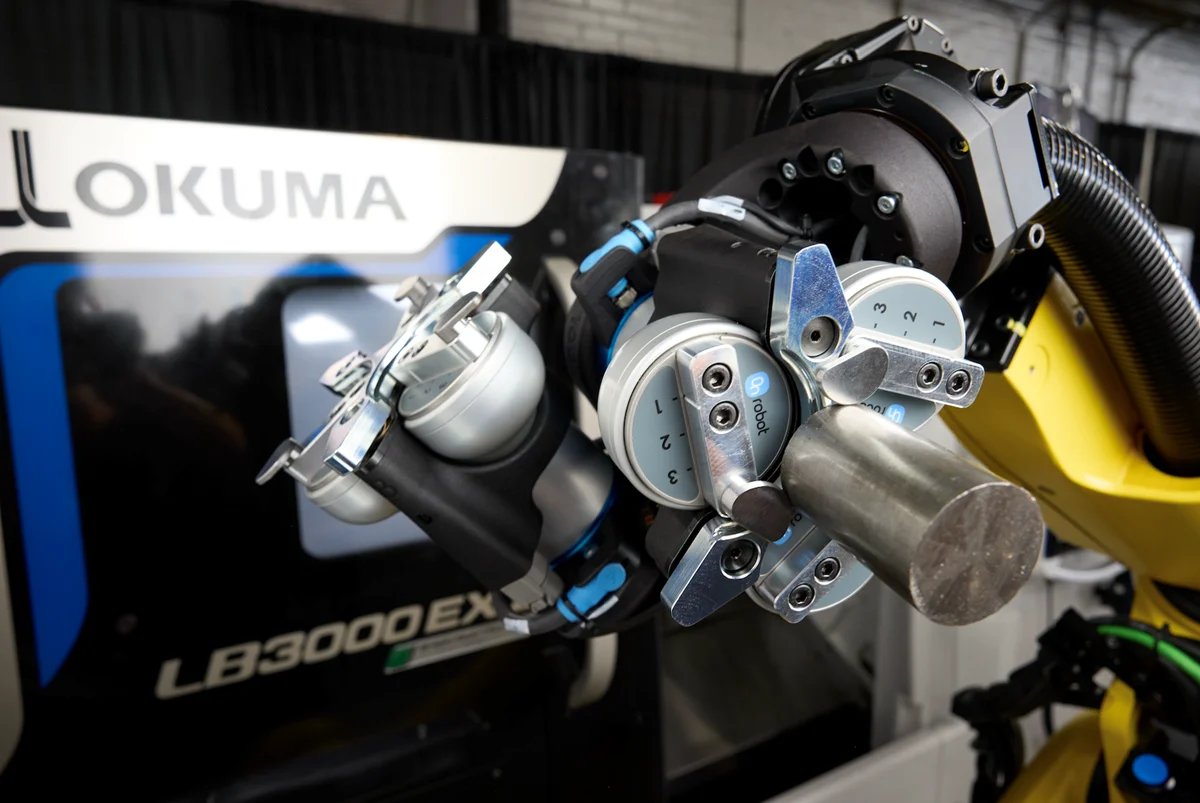
Add Flexibility and Speed to Your Operation with Next-Generation Robotics by Okuma
Why It Matters
The enhancements dramatically cut changeover time and broaden part flexibility, giving manufacturers a faster, more adaptable path to full‑machine automation and higher throughput.
Key Takeaways
- •Electric grippers replace pneumatics, expanding part size range to 2‑3 inches
- •Integrated laser sensor halves changeover time by auto‑measuring part dimensions
- •QuickTouch HMI enables new part setup in under 10 clicks
- •ORL‑MC II handles up to 90 pallets, supporting 18 SKUs simultaneously
- •ORL‑PLUS series will automate two‑machine workflows with pre‑engineered modules
Pulse Analysis
Manufacturers are under pressure to increase productivity while handling ever‑more diverse part geometries. Okuma’s second‑generation ORL Mark‑II series answers that call by marrying advanced robotics with user‑friendly software. The shift from pneumatic to electric grippers, coupled with programmable force control ranging from 50 to 450 newtons, lets the system grip thin‑walled components without damage and accommodate part diameters from 0.5 in to over 5 in. An integrated laser sensor automatically measures part height, eliminating manual data entry and cutting changeover time by roughly 50 percent, a gain that directly translates to higher machine uptime.
Beyond the hardware upgrades, Okuma’s QuickTouch HMI transforms robot programming into a smartphone‑like experience. Operators can set up a new part with fewer than ten clicks, store part‑specific parameters, and monitor real‑time diagnostics—all without writing code. The ORL‑MC II’s rotating station can hold up to 90 pallets and manage 18 distinct SKUs, enabling mixed‑model production on a single cell. This pallet‑centric capability reduces manual loading, improves part traceability, and supports high‑accuracy machining for industries ranging from aerospace to medical devices.
Looking ahead, the forthcoming ORL‑PLUS series will extend these benefits to dual‑machine workflows, integrating drawer, pallet and conveyor handling with pre‑engineered functions such as part flipping and marking. By offering a turnkey, engineer‑supported solution, Okuma lowers the barrier for shops to adopt multi‑machine automation, positioning itself as a key enabler of Industry 4.0 strategies. As labor costs rise and demand for rapid, low‑volume production grows, these next‑gen robotics are likely to become a competitive differentiator for manufacturers seeking both flexibility and speed.
Add Flexibility and Speed to Your Operation with Next-Generation Robotics by Okuma
Comments
Want to join the conversation?
Loading comments...