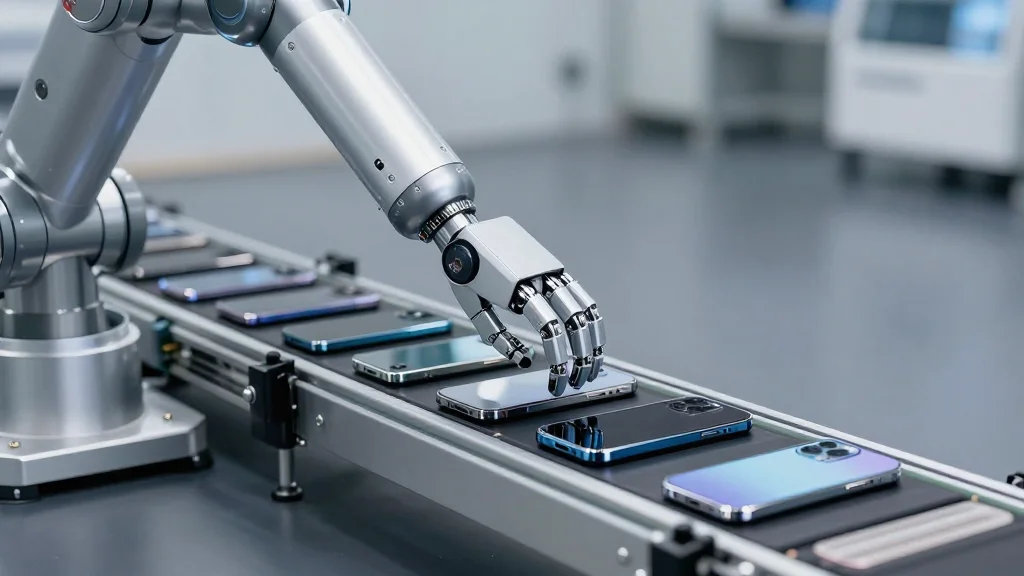
Agibot Deploys Humanoid Robots on Chinese Consumer‑Electronics Line, Targeting 100 Units by 2026

Companies Mentioned
Why It Matters
The deployment signals a turning point for collaborative robotics in China’s high‑mix, high‑volume manufacturing segment. By proving that humanoid robots can sustain 99%+ uptime and handle delicate electronics tasks without bespoke tooling, Agibot lowers the barrier for other factories to adopt similar systems, potentially reshaping labor dynamics and productivity benchmarks. For global supply chains, increased automation in Chinese consumer‑electronics factories could tighten lead times and reduce variability, affecting downstream OEMs and retailers worldwide. The move also underscores Beijing’s broader policy agenda to embed AI and robotics into core industries, accelerating the country’s transition from low‑cost labor to technology‑driven manufacturing.
Key Takeaways
- •Agibot deployed G2 humanoid robots on Longcheer Technology's consumer‑electronics line, achieving 310 units/hour.
- •Cycle times are 19‑20 seconds with continuous operation rates above 99%.
- •Deployment completed in 36 hours and supports 24/7 autonomous operation.
- •Company plans to expand to 100 robots by the end of 2026, targeting semiconductors and energy sectors.
- •Agibot produced its 10,000th robot this year after a rapid production ramp.
Pulse Analysis
Agibot’s rollout arrives at a moment when Chinese manufacturers are under pressure to offset rising labor costs and tighten quality controls. The G2’s ability to operate without custom fixtures means factories can retrofit existing lines quickly, a key advantage over traditional industrial arms that require extensive re‑engineering. This agility could accelerate adoption across midsize plants that previously hesitated due to capital outlays.
Historically, China’s automation narrative has been dominated by fixed‑base collaborative robots from firms like Siasun and ABB. Agibot’s humanoid approach introduces a mobile, perception‑driven alternative that can navigate complex floor plans and reassign tasks on the fly. If the promised economic value materializes, it may spur a wave of investment in embodied AI platforms, prompting incumbents to either partner with or acquire emerging players to stay competitive.
Looking ahead, the real test will be scaling beyond a single line to multi‑plant deployments while maintaining the reported 99%+ uptime. Success could trigger a cascade effect, prompting OEMs in the United States and Europe to reconsider offshoring strategies, knowing that Chinese factories can now deliver high‑mix electronics at speed and precision previously associated with high‑cost regions. Conversely, any setbacks—such as unexpected downtime or integration challenges—could temper enthusiasm and reinforce the need for hybrid human‑robot workflows rather than full automation.
Agibot Deploys Humanoid Robots on Chinese Consumer‑Electronics Line, Targeting 100 Units by 2026
Comments
Want to join the conversation?
Loading comments...