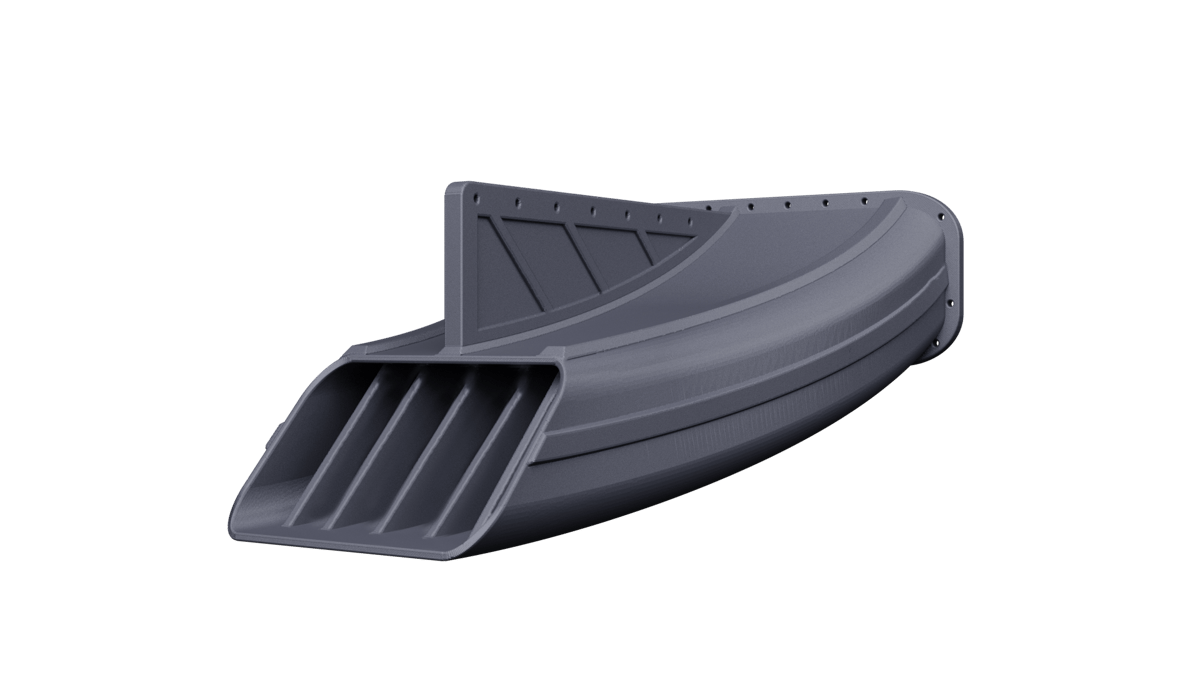
Application Spotlight: Consolidated Helicopter Intake Duct Yields 80% Cost Saving
•February 27, 2026
0
Why It Matters
Achieving an 80% cost reduction on a safety‑critical component reshapes budgeting for helicopter programs and validates additive manufacturing for high‑performance aerospace applications.
Key Takeaways
- •Additive manufacturing cut intake duct cost by 80%.
- •Carbon-PEEK 3D printing reduced part weight and lead time.
- •Consolidated design eliminated multiple sub‑assemblies.
- •OEM achieved improved airflow efficiency and reliability.
- •Technology scalable to other aerospace components.
Pulse Analysis
Additive manufacturing has moved from prototyping to full‑scale production in aerospace, driven by the need for lighter structures, complex geometries, and faster supply chains. Traditional machining of metal or composite parts often involves multiple setups, expensive tooling, and long lead times, especially for low‑volume, high‑performance components. By leveraging powder‑bed fusion of high‑temperature polymers such as carbon‑reinforced PEEK, manufacturers can produce parts that meet stringent thermal and mechanical requirements while also enabling design freedom not possible with subtractive methods. These capabilities also support on‑demand production, reducing stockpiling and enabling rapid design iterations.
The OEM’s intake duct redesign illustrates those advantages. Instead of assembling several machined sections, the team printed a single, consolidated duct using carbon‑PEEK, which tolerates the high‑temperature environment of a helicopter’s combustion chamber. The new part achieved an 80 % reduction in material, tooling and labor costs, and its weight dropped by roughly 30 %. Bench tests confirmed that airflow performance matched or exceeded the legacy design, preserving engine efficiency and flight safety.
Beyond the immediate savings, the case signals a broader shift toward digital‑first production for aerospace subsystems. The ability to consolidate parts reduces inventory complexity and improves reliability by eliminating mechanical joints that can fail under vibration. As certification pathways for high‑performance polymers mature, more OEMs are likely to adopt similar strategies for fuel‑nozzles, ducts, and structural brackets, accelerating the industry’s transition to lighter, more cost‑effective fleets. Ultimately, the 80 % cost cut demonstrates that additive manufacturing can deliver both economic and performance benefits on critical, safety‑sensitive components.
Application spotlight: Consolidated helicopter intake duct yields 80% cost saving
0
Comments
Want to join the conversation?
Loading comments...