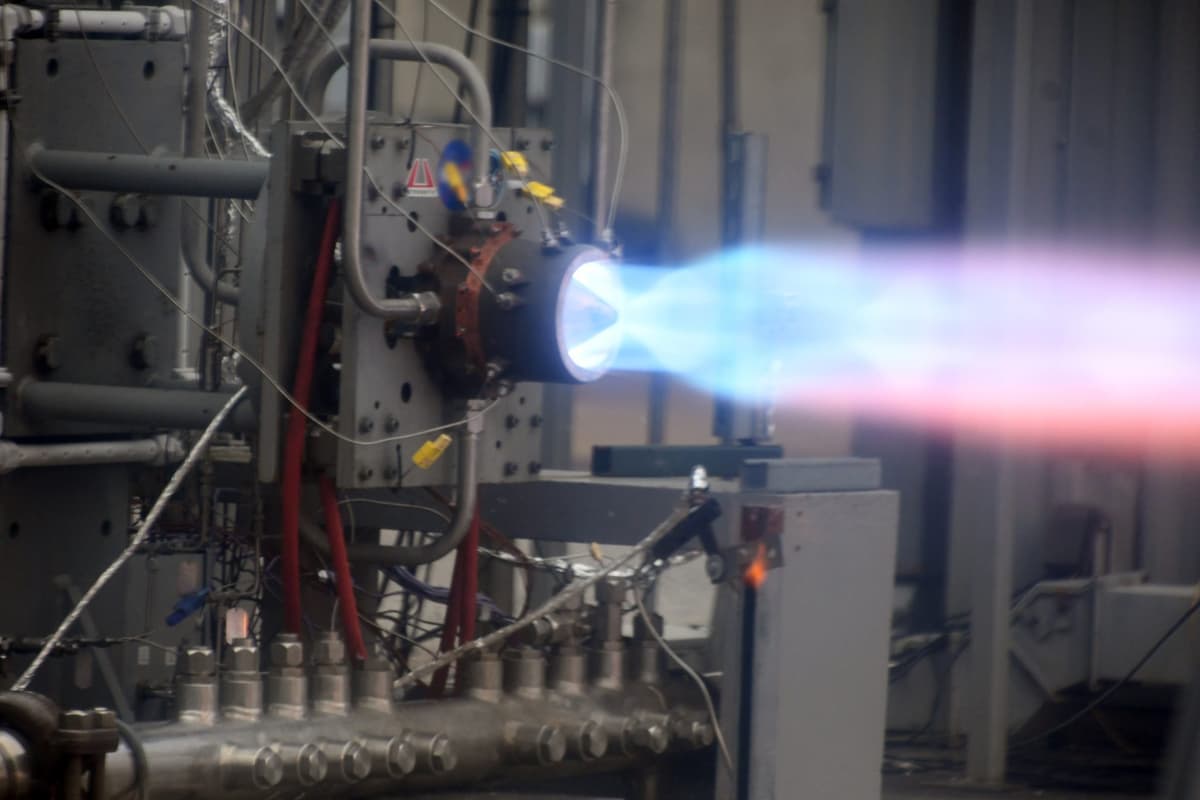
Astrobotic Uses Patented Metal 3D Printing Technology to Break Rotating Detonation Engine Records
Companies Mentioned
Why It Matters
The milestone validates rotating detonation technology as a viable, high‑performance propulsion option, potentially lowering launch mass and cost for cislunar missions. It also showcases how additive manufacturing can overcome long‑standing engineering barriers in advanced rocket engines.
Key Takeaways
- •Chakram achieved 300‑second continuous RDRE burn, longest on record.
- •PermiAM’s tunable porosity improves thermal management and combustion stability.
- •Each prototype generated over 4,000 pounds of thrust, among the strongest RDREs.
- •NASA SBIR funding enabled novel injector designs and additive‑manufactured components.
- •Astrobotic plans to integrate Chakram into lunar landers and orbital transfer vehicles.
Pulse Analysis
Astrobotic’s breakthrough hinges on PermiAM, a patented metal additive‑manufacturing process co‑developed with Elementum3D. By controlling porosity at the microscale, PermiAM creates internal lattice structures that act as built‑in heat exchangers, allowing precise thermal regulation inside the engine’s combustion chamber. This capability addresses one of the longest‑standing hurdles for rotating detonation rocket engines—maintaining material integrity under extreme temperature gradients. The technology also enables complex injector geometries that would be impossible with traditional machining, turning what was once a theoretical concept into a testable hardware platform.
Rotating detonation rocket engines (RDREs) differ from conventional rockets by igniting fuel in supersonic detonation waves that travel around a circular chamber, extracting up to 15 % more specific impulse and delivering a higher thrust‑to‑weight ratio. Astrobotic’s Chakram prototypes produced over 4,000 pounds of thrust and completed a 300‑second continuous burn—the longest recorded for an RDRE—while reaching thermal steady‑state, a hallmark of stable operation. These milestones prove the concept scalable and open the path for lighter lunar landers and in‑space transfer vehicles without sacrificing performance.
With the successful hot‑fire campaign, Astrobotic is positioning Chakram as a core propulsion option for its upcoming Griffin‑class lunar landers, Xodiac‑ and Xogdor‑class reusable rockets, and a dedicated orbital transfer vehicle. The next development phase will focus on regenerative cooling, throttling capability, and further mass reduction, leveraging PermiAM’s porosity control to streamline cooling channels. As NASA and commercial partners continue to fund RDRE research through SBIR programs, the technology could accelerate cislunar logistics, reduce launch costs, and spur competition among emerging space‑flight firms seeking higher efficiency engines.
Astrobotic Uses Patented Metal 3D Printing Technology to Break Rotating Detonation Engine Records
Comments
Want to join the conversation?
Loading comments...