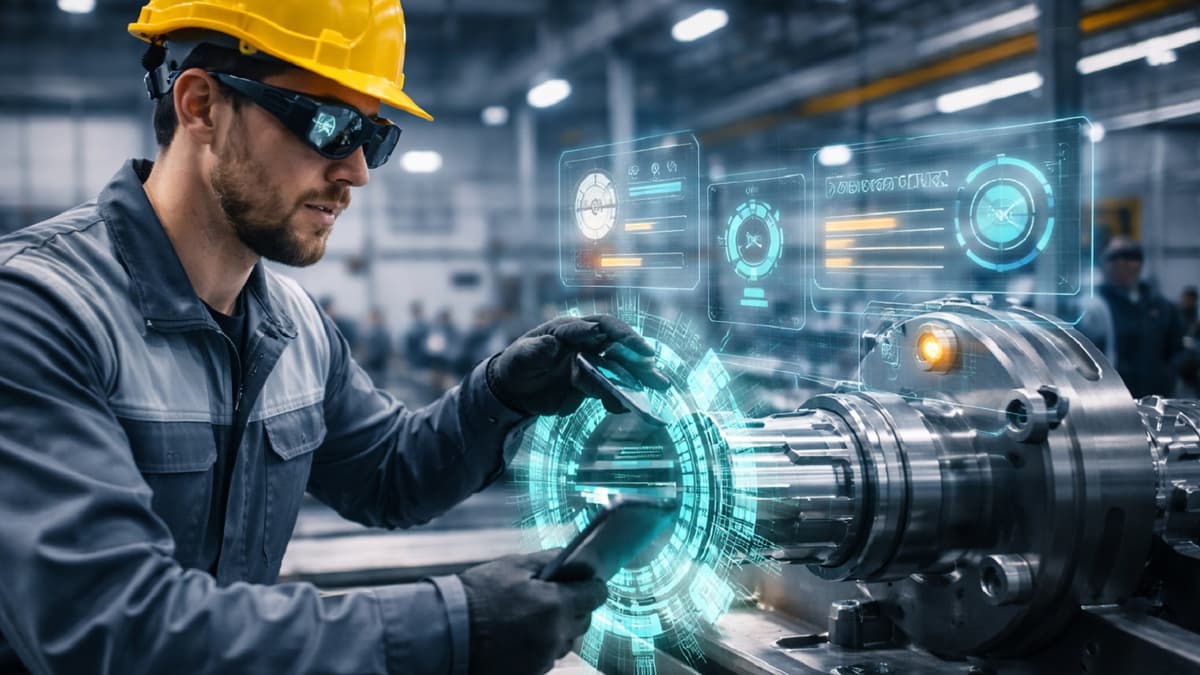
Augmented Reality Digitalizes and Optimizes Processes for Frontline Workers
Why It Matters
Embedding AR at the shop floor reduces error rates, shortens downtime and addresses the looming skills gap, making it a strategic lever for manufacturers seeking competitive advantage in the smart‑factory era.
Key Takeaways
- •AR overlays real-time instructions on equipment, cutting task time.
- •Interactive workflows replace static manuals, reducing errors.
- •Metrology gains visual guidance, shortening inspection cycles.
- •Remote expert support via AR accelerates training and downtime recovery.
- •Integrated AR creates live data loop, boosting factory agility.
Pulse Analysis
Manufacturers have long championed digital twins and IoT, yet the human operator often remains the weak link in the digital thread. AR bridges that gap by delivering contextual information directly within a worker’s line of sight, eliminating the need to consult separate screens or paper manuals. This seamless access not only trims cycle times but also lowers cognitive load, leading to measurable reductions in mistake‑related rework. Early adopters report up to a 30% improvement in first‑time‑right assembly when AR guidance is paired with real‑time machine data.
In quality‑critical environments such as metrology, AR’s visual cues transform abstract tolerance specifications into concrete, on‑part annotations. Inspectors can see exactly where to place probes and instantly compare readings against target limits, compressing inspection loops by an estimated 20‑40%. Simultaneously, AR serves as a portable knowledge repository; senior technicians record procedural nuances that novices can replay on demand. Remote collaboration tools further extend this benefit, allowing experts to overlay annotations on a worker’s view from across the globe, accelerating fault diagnosis and minimizing unplanned downtime.
Looking ahead, the convergence of AR with spatial computing, AI‑driven analytics and high‑resolution digital twins will elevate the technology from assistance to autonomous decision‑making. Predictive alerts could appear before a component fails, and adaptive workflows might reconfigure themselves based on real‑time performance data. For firms weighing ROI, the key is to target high‑impact use cases—safety‑critical tasks, complex assemblies and precision inspections—where AR can deliver quantifiable gains in efficiency, quality and workforce readiness. As hardware becomes lighter and software ecosystems mature, AR is poised to become a foundational layer of the next generation smart factory.
Augmented Reality Digitalizes and Optimizes Processes for Frontline Workers
Comments
Want to join the conversation?
Loading comments...