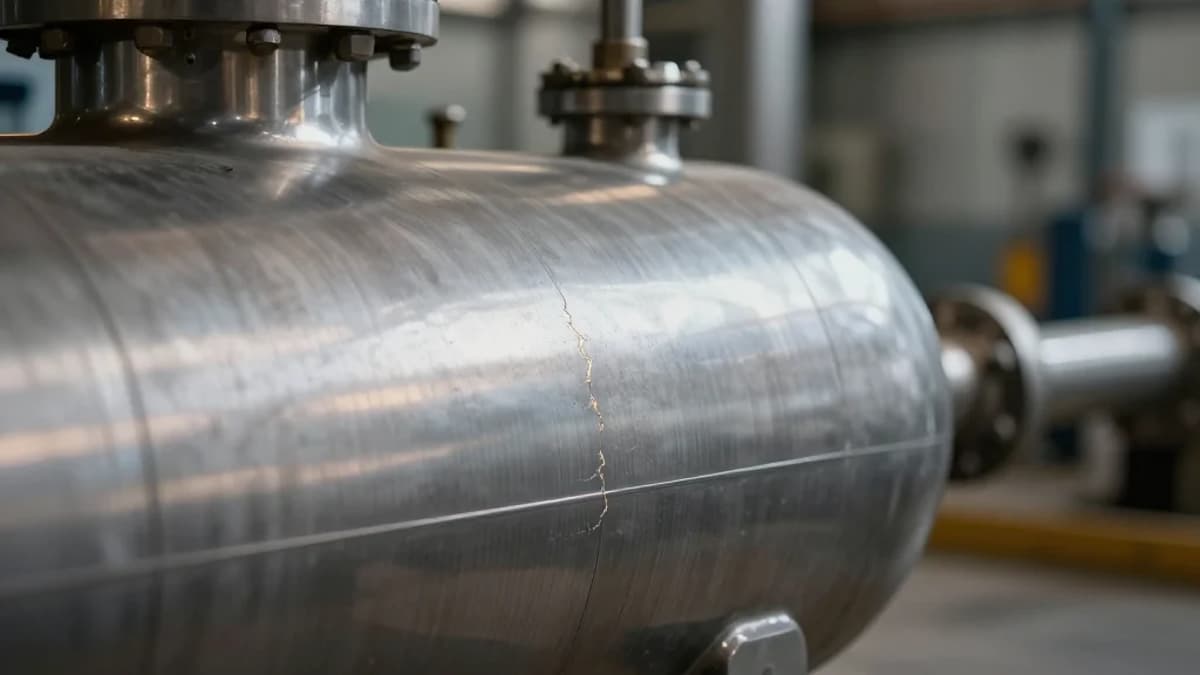
By standardizing brittle‑fracture assessment, the guidance reduces failure risk and aligns industry codes, protecting high‑value assets and personnel.
Brittle fracture remains a leading cause of catastrophic failures in carbon and low‑alloy steel pressure equipment, especially when operating near the ductile‑to‑brittle transition temperature. The phenomenon hinges on three interrelated factors—crack‑like defects, applied or residual stresses, and material fracture toughness—each of which can be quantified through advanced inspection techniques and Charpy V‑notch testing. WRC Bulletin 599 consolidates decades of failure analysis to illustrate how these variables interact, providing a clear framework for engineers tasked with safeguarding critical infrastructure.
The bulletin’s most consequential contribution is its shift from prescriptive, code‑specific screening to a unified, fracture‑mechanics‑based methodology. By leveraging stress intensity factors, J‑integral concepts, and temperature‑dependent toughness data, the new procedures enable more accurate predictions of crack propagation risk for both new construction and existing assets undergoing Fitness‑For‑Service assessments. This approach not only bridges gaps among ASME Sections VIII‑1, VIII‑2, B31.1, B31.3, B31T, and API 579 but also equips practitioners with a consistent toolset for evaluating low‑temperature limits, residual stress mitigation, and post‑weld heat‑treatment effectiveness.
Industry impact extends beyond technical precision. The adoption of WRC 599’s recommendations is set to drive the forthcoming Annex 3B of API 579‑1/ASME FFS‑1, fostering greater code harmonization and reducing redundant compliance efforts across the oil‑and‑gas, petrochemical, and power sectors. Moreover, the establishment of an ASME Board of Pressure Technology Codes and Standards task group underscores a collaborative commitment to updating low‑temperature criteria across multiple standards. As organizations integrate these insights, they can expect enhanced reliability, lower inspection costs, and a stronger safety culture that aligns with evolving regulatory expectations.
Developing and Preserving Knowledge through WRC’s Contributions to ASME and API Codes and Standards
By Brian R. Macejko, P.E. – Principal Engineer I at EQUITY
Appears in the November/December 2025 issue of Inspectioneering Journal
This is the second installment of “Behind the Bulletin,” a regular Inspectioneering Journal column dedicated to highlighting key technical contributions found within the 70+ years of the Welding Research Council, Inc. (WRC) Bulletins. This article provides an overview of WRC Bulletin 599, “Recommendations for Evaluating Resistance to Brittle Fracture for Carbon and Low‑Alloy Steel Equipment and Piping” (WRC 599). WRC 599 was published in 2023 and serves as the technical basis and background for a new upcoming Annex 3B in the next publication of API 579‑1/ASME FFS‑1, “Fitness‑For‑Service” (API 579). Publication of WRC 599 also served as the catalyst for establishing a new ASME Board of Pressure Technology Codes and Standards (ASME BPTCS) task group charged with revamping and harmonizing the assessment procedures used to establish low‑temperature limits across several ASME Codes.
WRC 599 provides an overview of the critical parameters that influence susceptibility to brittle fracture failures, and a detailed review of several significant brittle‑fracture failures that have occurred in industry. The bulletin summarizes the current brittle‑fracture screening procedures in ASME Section VIII, Division 1 (ASME VIII‑1), ASME Section VIII, Division 2 (ASME VIII‑2), ASME B31.1, ASME B31.3, ASME B31T, and API 579. The background, technical basis, and evolution of the procedures are thoroughly documented, and WRC 599 highlights the numerous inconsistencies and deficiencies with the current procedures. New brittle‑fracture screening procedures anchored in state‑of‑the‑art fracture mechanics are introduced, along with the supporting technical basis and justification. The newly proposed procedures are intended for consideration in the design and construction of new pressure vessels and piping systems, as well as for implementation in post‑construction Fitness‑For‑Service (FFS) assessments of existing equipment and piping.
Brittle fracture is the sudden, rapid propagation of a crack‑like flaw under stress (residual or applied) where the material exhibits little or no evidence of ductility or plastic deformation. This definition outlines the three key components that drive susceptibility to brittle fracture failures in carbon and low‑alloy steels (see Figure 1).

Figure 1. Key components that influence susceptibility to brittle fracture.
Crack‑like defect: Brittle fracture typically initiates at a crack‑like flaw or defect. Defects can result from environmental damage (e.g., wet H₂S or caustic exposure), mechanical damage (e.g., gouges, dents, or fatigue), or from original fabrication (e.g., laminations, lack of fusion, lack of penetration, slag inclusions, or porosity). When appropriate, detailed inspection—including surface‑examination techniques such as dye‑penetrant or magnetic‑particle examination, and volumetric techniques such as angle‑beam ultrasonic examination—may be utilized to detect and characterize any crack‑like defects present in pressure equipment and piping systems.
Stress (residual and/or applied): Stress provides the energy necessary to drive a defect to fracture. Typical sources of stress include pressure, weight, external forces and moments, thermal loads, and residual stress from welding processes. A properly designed and executed post‑weld heat‑treatment (PWHT) stress‑relief operation will significantly reduce weld residual stress.
Material fracture toughness: Fracture toughness is the ability of a material to absorb energy and plastically deform without fracturing. For carbon and low‑alloy steel, toughness is a function of metal temperature, as well as material strength, ductility, chemistry, grain size, and heat treatment. Although not a direct measure of material fracture toughness, Charpy V‑notch (CVN) impact testing is commonly used to provide insight into a material’s brittle‑to‑ductile transition (see Figure 2).
(Figure 2 would be placed here in the original article.)

Brian Macejko is the Chair of the API/ASME Joint Committee on Fitness‑For‑Service, API 579‑1/ASME FFS‑1 (API 579) and an ex‑officio member of the ASME Board on Pressure Technology Codes & Standards (ASME BPTCS). He brings experience as both an owner‑user and consultant providing engineering support and training to the refining, oil and gas, fertilizer, pulp & paper, food, and related process industries.
Comments
Want to join the conversation?
Loading comments...