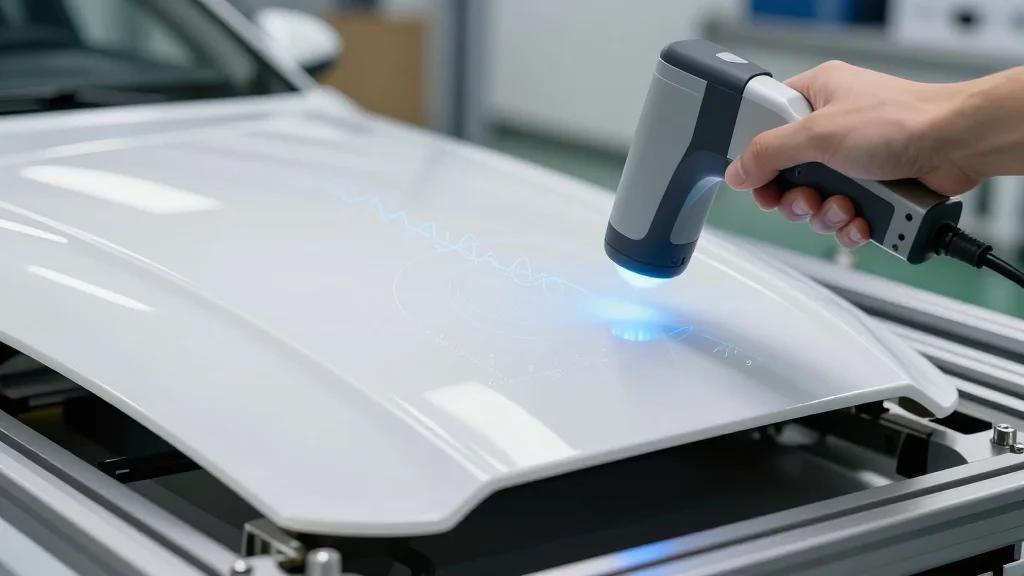
BMW Leipzig Plant Deploys Terahertz Imaging to Boost Paint Quality on Plastic Parts

Companies Mentioned
Why It Matters
The terahertz deployment at Leipzig marks a concrete step toward fully digital, waste‑free quality assurance in automotive manufacturing. By eliminating destructive testing, BMW reduces material loss, shortens inspection cycles, and gathers high‑resolution data that can feed machine‑learning models for predictive quality control. As the industry pushes for lighter, more plastic‑rich vehicle bodies, scalable, non‑contact inspection methods become essential to maintain paint integrity and meet stringent durability standards. Beyond BMW, the successful integration of das‑Nano’s “Irys” system could accelerate adoption of terahertz technology across the broader manufacturing sector, from aerospace composites to consumer‑electronics housings. The case demonstrates that high‑frequency electromagnetic sensing can move from laboratory prototypes to high‑volume production lines, potentially reshaping how manufacturers verify coating thickness, bond quality, and material uniformity.
Key Takeaways
- •BMW Leipzig plant installs das‑Nano’s terahertz “Irys” system for inline paint‑thickness measurement
- •Non‑destructive inspection replaces manual scalpels and microscopy, cutting part waste
- •Micrometre‑level accuracy achieved in seconds, enabling real‑time quality data
- •Digital measurements feed into plant‑wide analytics, supporting predictive quality models
- •First BMW Group use on exterior plastics; rollout to full operation by Q3 2026
Pulse Analysis
BMW’s decision to embed terahertz imaging into its Leipzig line reflects a broader strategic pivot toward sensor‑driven quality assurance. Historically, automotive paint inspection relied on tactile gauges or destructive cross‑section analysis—methods that are labor‑intensive and generate scrap. The terahertz approach sidesteps these constraints, offering a contactless, high‑throughput alternative that aligns with Industry 4.0 objectives.
From a cost perspective, the upfront investment in robotics and das‑Nano’s proprietary hardware is likely offset by reductions in re‑work, warranty claims, and material waste. While BMW has not disclosed the capital outlay, comparable terahertz installations in aerospace have run in the low‑hundreds of millions of euros, suggesting a multi‑year payback horizon predicated on efficiency gains and sustainability metrics. Moreover, the digital data stream creates a foundation for advanced analytics—something traditional manual methods cannot provide.
Competitively, early adopters of terahertz inspection can differentiate themselves on paint quality consistency, a key factor in perceived vehicle premium. As OEMs race to increase the share of lightweight plastics, the ability to guarantee uniform coating without sacrificing throughput becomes a decisive advantage. If BMW can demonstrate measurable reductions in defect rates and material costs, other manufacturers—both within the VW Group and among rivals—will likely accelerate similar deployments, potentially spawning a new ecosystem of terahertz‑enabled inspection vendors.
Looking ahead, the technology’s scalability will be tested as BMW evaluates extensions to metal panels and composite structures. Success could spur a cascade of investments in complementary AI‑driven defect detection, turning raw terahertz data into actionable insights across the entire body‑shop. In that scenario, terahertz imaging would evolve from a niche quality tool to a cornerstone of the next generation of smart factories.
BMW Leipzig Plant Deploys Terahertz Imaging to Boost Paint Quality on Plastic Parts
Comments
Want to join the conversation?
Loading comments...