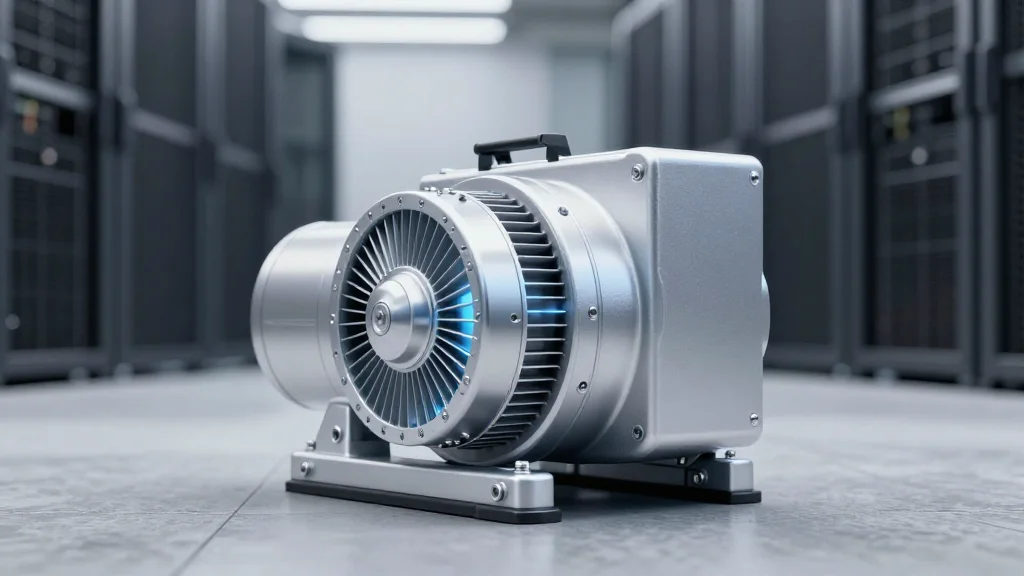
BorgWarner Secures $300 Million Data‑Center Power Deal with TurboCell

Companies Mentioned

Why It Matters
BorgWarner’s entry into data‑center power equipment underscores a strategic shift for manufacturers traditionally anchored in automotive supply chains. As data centers consume an ever‑growing share of global electricity, the demand for reliable, low‑emission backup and prime power solutions is accelerating. By repurposing its turbocharger and thermal‑management expertise, BorgWarner aims to capture a portion of an $8.5 billion market, potentially smoothing earnings volatility tied to automotive cycles and EV‑transition challenges. The deal also signals to peers that core engineering competencies can be redeployed across sectors, prompting a wave of diversification among drivetrain and component makers. The partnership could reshape competitive dynamics in the industrial power space. Established generators manufacturers will face new entrants with advanced fuel‑flexibility and integrated electronics, raising the bar for efficiency and emissions compliance. If BorgWarner succeeds, it may encourage further cross‑industry collaborations, accelerating innovation in modular, multi‑fuel power solutions that serve both data‑center and broader grid‑resilience needs.
Key Takeaways
- •BorgWarner signed a master supply agreement with TurboCell to provide modular turbine generators for data centers.
- •First‑year sales from the contract are projected to exceed $300 million, with production slated for 2027.
- •The generators will be fuel‑flexible (natural gas, propane, diesel, hydrogen) and 65 % of system content will be sourced in‑house.
- •BorgWarner expects mid‑teens incremental margins and earnings‑per‑share accretion in the first year of the new business.
- •The deal diversifies BorgWarner’s revenue away from its core automotive business, which still accounts for over 80 % of total sales.
Pulse Analysis
BorgWarner’s data‑center generator contract is a textbook case of leveraging legacy engineering assets to tap a high‑growth, non‑automotive market. The company’s core competency—high‑speed, thermally robust turbo machinery—translates naturally to modular generators that must operate continuously under demanding conditions. By controlling the majority of component content, BorgWarner can differentiate on reliability and integration speed, two factors that hyperscalers prize when evaluating backup power solutions.
Historically, automotive suppliers have struggled to find footholds outside the vehicle ecosystem, often stumbling over scale or regulatory barriers. BorgWarner’s approach sidesteps many of these pitfalls by targeting a market where its existing supply chain, especially in power electronics and fuel‑system design, already aligns with customer requirements. The fuel‑flexibility aspect also positions the firm ahead of competitors still focused on single‑fuel diesel or gas units, catering to emerging sustainability mandates that many data‑center operators are adopting.
However, the venture is not without risk. Scaling production to meet the projected $300 million sales by 2027 will demand significant capital investment and a rapid learning curve in a sector dominated by entrenched players. Moreover, the company’s automotive segment remains exposed to the volatile EV transition, which could erode cash flow needed for the new venture. Investors will be watching the first shipments closely; successful delivery and performance will likely validate the diversification thesis, while any delays or reliability issues could reinforce skepticism about cross‑industry pivots. In the broader manufacturing landscape, BorgWarner’s move may act as a catalyst, prompting other drivetrain firms to explore similar opportunities in data‑center power, grid storage, or even renewable‑energy equipment, reshaping the competitive map of industrial manufacturing over the next decade.
BorgWarner Secures $300 Million Data‑Center Power Deal with TurboCell
Comments
Want to join the conversation?
Loading comments...