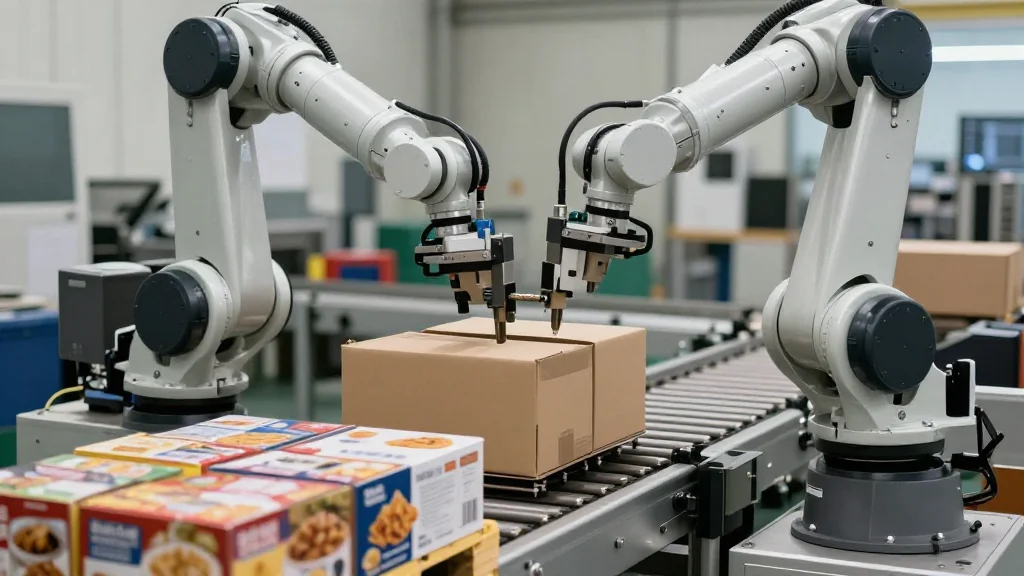
Case Packing and Palletizing Automation in 2026: Adapting to SKU Growth and Tighter Labor Markets
Companies Mentioned
Why It Matters
Automation that shortens changeover time and mitigates labor gaps directly protects throughput and product quality, giving food producers a competitive edge in a market demanding rapid SKU expansion.
Key Takeaways
- •Quick‑change case packers cut SKU changeover from 60 min to minutes
- •Labor shortages push food plants to treat automation as staffing solution
- •Software pallet pattern libraries enable config switches in seconds
- •Single‑source automation reduces multi‑vendor coordination and downtime
- •Robotic end‑of‑line ROI often achieved within 12‑24 months
Pulse Analysis
The proliferation of product variants has become a defining challenge for food manufacturers. Over the past decade, SKU counts have multiplied, forcing end‑of‑line stations to handle an ever‑wider array of case sizes and pallet configurations. Traditional manual changeovers can consume up to an hour per SKU, eroding line efficiency and inflating labor costs at a time when the industry faces a persistent shortage of workers willing to perform repetitive, physically demanding tasks.
To address these pressures, vendors like Pacteon are embedding flexibility into the core design of case packers and palletizers. Features such as ProAdjust’s one‑button format alignment and OptiStak’s recipe‑based pallet pattern software let operators reconfigure lines in minutes without specialist intervention. This hardware‑software synergy not only slashes downtime but also delivers measurable ROI, with many facilities recouping investment within 12 to 24 months thanks to higher throughput and reduced scrap caused by human error.
Strategically, adopting modular, integrated automation reshapes how food plants plan for growth. A single‑source partner that supplies cartoners, conveyors, stretch wrappers, and robotic palletizers simplifies system integration and minimizes the coordination burden of multi‑vendor projects. As labor markets remain tight and consumer demand for variety accelerates, flexible end‑of‑line automation is evolving from an optional efficiency upgrade to a critical component of long‑term operational resilience.
Case Packing and Palletizing Automation in 2026: Adapting to SKU Growth and Tighter Labor Markets
Comments
Want to join the conversation?
Loading comments...