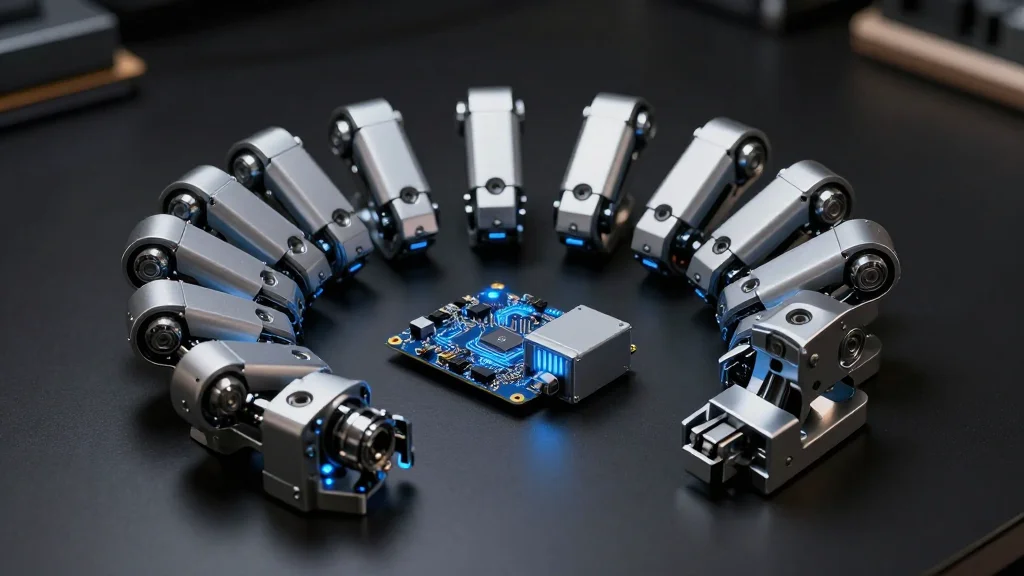
China Forms Shenzhen Consortium to Build Domestic Robot Electronics Stack

Why It Matters
A unified domestic electronics architecture could dramatically lower the cost of robot production in China, making advanced automation more accessible to small and medium‑size manufacturers. By eliminating reliance on foreign communication protocols and real‑time operating systems, the consortium also strengthens national security and reduces exposure to export controls. If the consortium succeeds, it may shift the global balance of robot component supply, compelling foreign vendors to compete on price and performance in a market that currently dominates the world’s robot shipments. The ripple effect could accelerate the adoption of Chinese‑made robots in sectors ranging from automotive assembly to logistics, further entrenching China’s leadership in industrial automation.
Key Takeaways
- •Consortium launched on April 22 by Shenzhen Robot Association, Beijing Robot Innovation Center, Dongtu Technology, and Dongfang Precision Engineering
- •Goal: develop an open, unified domestic electronics stack for robots to replace foreign standards
- •2025 China shipped ~14,400 humanoid robots, >80% of global market; 2026 shipments projected >60,000 units
- •Li Ping, Dongtu Technology chairman, warned of fragmented tech routes and foreign protocol dependence
- •Consortium aims to release a common technical spec within six months and start pilot projects later in 2026
Pulse Analysis
The formation of the Domestic Robot Electronic Architecture Consortium reflects a strategic pivot from incremental component sourcing to systemic supply‑chain redesign. Historically, Chinese robot manufacturers have relied on imported microcontrollers, communication chips, and real‑time operating systems, creating a bottleneck that could be exploited by trade restrictions. By consolidating R&D around a home‑grown stack, the consortium not only mitigates that risk but also creates a platform for economies of scale that can drive down unit costs.
From a competitive standpoint, the consortium could force foreign vendors to accelerate localization efforts or risk losing a market that already commands 80% of global robot sales. The initiative also dovetails with Beijing’s broader "Made in China 2025" agenda, signaling that the government may back the effort with policy incentives, tax breaks, or direct funding. However, success hinges on the ability to attract top talent to develop a robust real‑time OS—a domain where China has traditionally lagged. If the consortium can close that gap, it will unlock tighter hardware‑software integration, faster iteration cycles, and ultimately, more reliable robots for high‑precision applications.
Looking ahead, the consortium’s progress will be a bellwether for China’s capacity to achieve true technological self‑sufficiency in high‑value manufacturing. Investors and OEMs should monitor the consortium’s specification releases and pilot outcomes, as they will likely dictate the next wave of capital allocation within the robot ecosystem.
China Forms Shenzhen Consortium to Build Domestic Robot Electronics Stack
Comments
Want to join the conversation?
Loading comments...