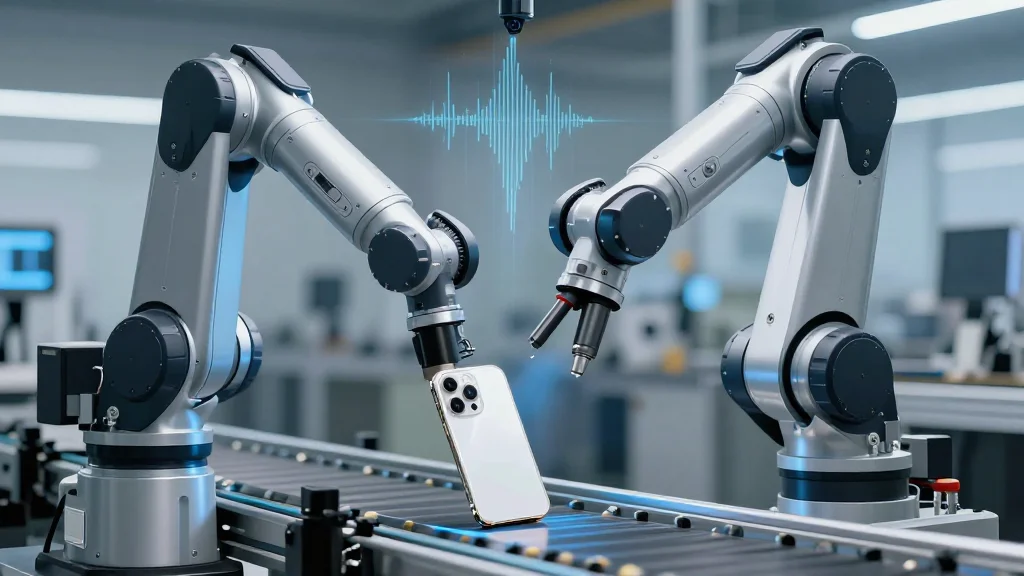
China’s AgiBot G2 Completes 8‑Hour Marathon Livestream, Showcasing Reliable Smart‑Factory Robotics

Companies Mentioned
Why It Matters
The successful marathon livestream provides concrete evidence that embodied AI can move beyond pilot projects into continuous, high‑volume manufacturing. For Chinese factories, the ability to replace or augment human labor with robots that adapt in real time could reduce labor costs, improve yield, and shorten time‑to‑market for new products. International competitors will also gauge China’s progress, potentially reshaping global supply‑chain dynamics as firms reassess where to locate smart‑factory investments. Beyond immediate productivity gains, the demonstration signals a shift in how manufacturers communicate technology readiness. By opening the production floor to a public audience, AgiBot and Longcheer are setting a new standard for transparency that could pressure other vendors to provide comparable proof points, accelerating the overall pace of automation adoption.
Key Takeaways
- •AgiBot G2 ran continuously for over eight hours with a 99.5% task success rate
- •Processed 310 units per hour, matching two human stations
- •Each operation took 18‑20 seconds, integrating with the factory’s MES in real time
- •Livestream attracted tens of thousands of viewers, providing public proof of reliability
- •Robot logged more than 140 cumulative stable hours, indicating durability for large‑scale deployment
Pulse Analysis
AgiBot’s marathon livestream is more than a publicity stunt; it is a strategic move to validate embodied AI at a scale that investors and corporate buyers can trust. Historically, Chinese robot manufacturers have excelled at hardware volume but lagged in AI integration. By showcasing a robot that can sense force, adjust on the fly, and communicate with MES software, AgiBot bridges that gap and positions itself against established Western players like ABB and Fanuc, which have been adding AI layers to legacy arms. The real differentiator is the robot’s ability to maintain human‑level throughput without the extensive re‑programming that typically follows product changes.
The broader market impact hinges on how quickly other manufacturers can replicate the conditions of the livestream. If AgiBot can demonstrate similar reliability across varied product lines—especially in high‑mix environments—the technology could become a cornerstone of China’s “Made in China 2025” vision, which emphasizes intelligent manufacturing. However, scaling will require robust data pipelines, cybersecurity safeguards for MES integration, and workforce upskilling to manage AI‑driven equipment. The next few months will reveal whether the marathon was an isolated success or the first step toward a new era of adaptive factory floors.
China’s AgiBot G2 Completes 8‑Hour Marathon Livestream, Showcasing Reliable Smart‑Factory Robotics
Comments
Want to join the conversation?
Loading comments...