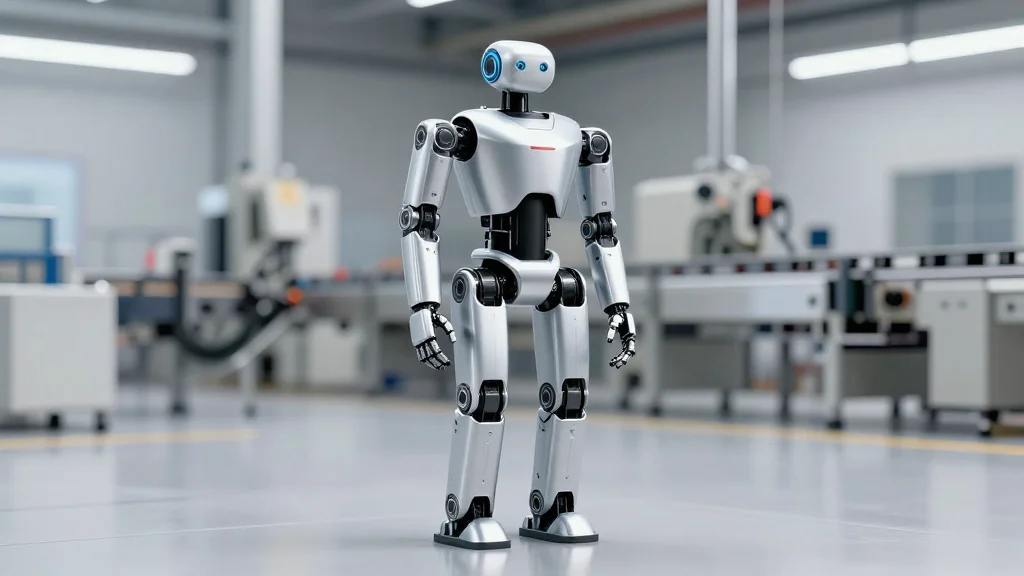
China’s Humanoid Robot Makers Ship Thousands, Target 5,000 Units This Year

Companies Mentioned

Why It Matters
The rapid expansion of China’s humanoid robot market signals a strategic pivot toward high‑mix, low‑volume automation that could reshape labor dynamics in a country facing demographic headwinds. If manufacturers succeed in moving beyond novelty demonstrations to reliable industrial roles, the technology could lower operating costs for logistics and service sectors, accelerating China’s competitiveness in advanced manufacturing. However, the gap between production capacity and functional demand also raises the risk of over‑investment, potentially leading to a correction that could affect venture capital flows and supply‑chain planning for component makers. Understanding whether the sector can achieve economies of scale will be critical for policymakers and investors alike.
Key Takeaways
- •Matrix Robotics reports ~1,000 orders and aims to ship 5,000 humanoid units in 2026.
- •Unit prices range from $99,000 (Matrix) to $26,600 (EngineAI).
- •China hosts >140 humanoid robot manufacturers and 330+ models as of 2025.
- •Morgan Stanley values the global humanoid robot market at $5 trillion.
- •State‑owned enterprises accounted for 2 billion yuan ($295 million) in orders in 2025.
Pulse Analysis
China’s humanoid robot surge is less a sign of immediate commercial viability than a bet on long‑term structural change. The country’s manufacturing ecosystem excels at scaling hardware, but the real differentiator will be AI integration that enables robots to operate in unstructured environments. Companies that can bundle robust perception stacks with affordable actuation will likely capture the industrial niche, while those focused on spectacle risk being sidelined.
Historically, China’s robot market has been dominated by fixed‑axis arms that excel at repetitive tasks. The shift to anthropomorphic platforms reflects a desire to address tasks that require mobility and dexterity—areas where traditional robots falter. If the projected 5,000‑unit delivery target is met without a corresponding rise in functional deployments, investors may reassess valuations, prompting a consolidation phase similar to the early 2020s AI chip market.
Policy will also play a decisive role. Government incentives aimed at mitigating labor shortages could accelerate adoption in sectors like eldercare, but regulatory scrutiny over safety and data privacy may temper enthusiasm. In the next 12‑18 months, the industry’s trajectory will hinge on three variables: the speed of AI software maturation, the emergence of clear ROI cases in logistics or public services, and the willingness of state‑owned buyers to transition from pilot projects to fleet‑wide rollouts.
China’s Humanoid Robot Makers Ship Thousands, Target 5,000 Units This Year
Comments
Want to join the conversation?
Loading comments...