CMM Adaptation to Future Manufacturing Demands
•March 2, 2026
0
Why It Matters
The shift to shop‑floor, automated CMMs accelerates quality feedback, reduces handling, and supports AI‑driven process adjustments, directly boosting yield and reducing scrap in high‑mix, high‑volume manufacturing.
Key Takeaways
- •Shop‑floor hardened CMMs withstand vibration, temperature, contaminants
- •Integrated CMM cells enable real‑time quality feedback
- •Equator‑X and Extol deliver high‑speed, compact inspection
- •Multi‑sensor CMMs fuse tactile, laser, vision data
- •Closed‑loop metrology drives adaptive process control and AI
Pulse Analysis
The manufacturing landscape is increasingly driven by high‑mix, low‑batch production where traditional metrology rooms become bottlenecks. Modern CMMs have been engineered with hardened structures, sealed guideways, and advanced temperature‑compensation algorithms that allow them to operate reliably amid the vibration, dust, and thermal swings of a typical shop floor. By placing measurement directly at the source, manufacturers eliminate costly part transport and align inspection cycles with takt time, delivering immediate quality signals without compromising the sub‑micron accuracy that downstream processes demand.
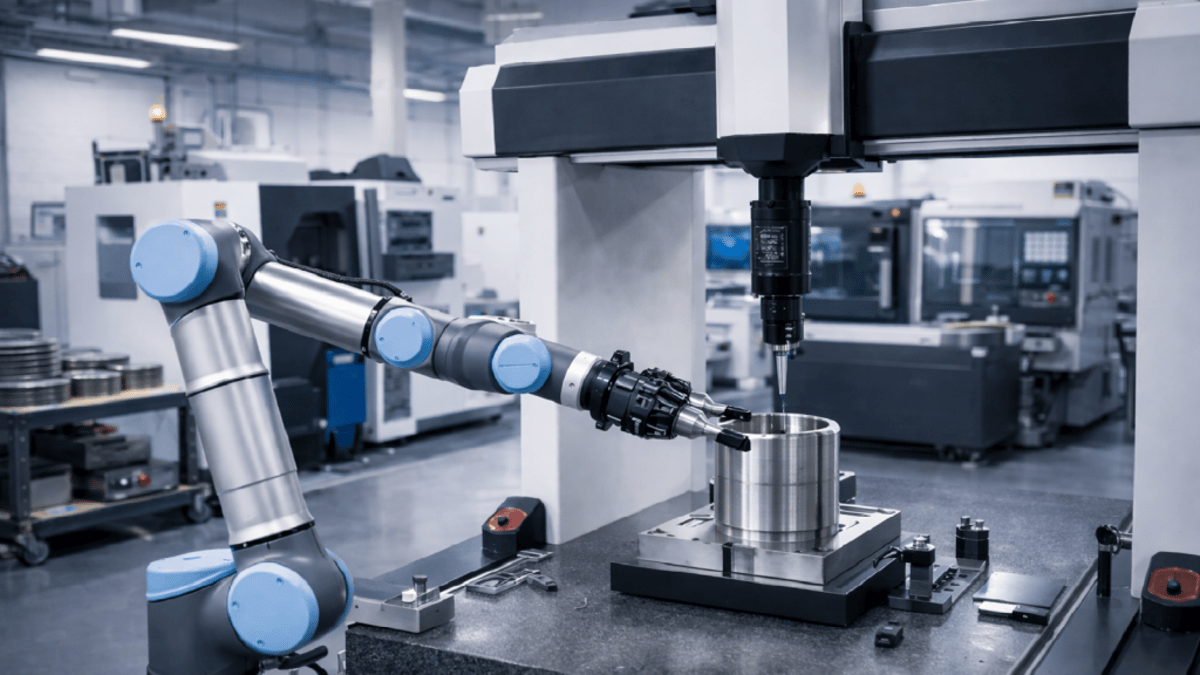
Automation is the next logical layer, and today’s CMMs are being built as plug‑and‑play nodes within robotic cells. Systems such as Renishaw’s Equator‑X and Aberlink’s Extol feature compact footprints, high‑speed continuous tactile scanning, and built‑in sensor‑change racks that combine tactile probes, laser line scanners, and vision cameras. This multi‑modal approach lets a single machine capture point data, full‑surface topology, and colour or texture information in a single pass, feeding downstream PLCs or MES platforms with actionable pass/fail decisions. The result is a dramatic lift in throughput while maintaining repeatability within a few microns.
The real strategic advantage emerges when measurement data is closed‑looped into production control. Integrated CMM cells can trigger real‑time adjustments to machining parameters, tool paths, or robotic handling based on AI‑driven analytics, effectively turning inspection from a checkpoint into a continuous process control signal. This capability underpins digital‑twin initiatives, reduces scrap rates, and shortens time‑to‑market for complex parts, especially those generated by additive manufacturing. As factories become more connected, CMMs will evolve from verification tools to intelligent actuators of quality, cementing their role in Industry 4.0 ecosystems.
CMM Adaptation to Future Manufacturing Demands
0
Comments
Want to join the conversation?
Loading comments...