Concepts NREC Updates Agile Engineering Design System
Companies Mentioned
Why It Matters
By automating data exchange and enriching analysis capabilities, the upgrade reduces manual effort, shortens development cycles, and lowers engineering costs for turbomachinery OEMs.
Key Takeaways
- •Added secondary leakage analysis for radial and axial turbomachines
- •Automated geometry transfer from AxCent to CTAADS reduces manual setup
- •MAX‑PAC now supports spiral roughing and 3+2 undercutting for blades
- •Centralized documentation interface standardizes output formats across projects
Pulse Analysis
The turbomachinery sector has long grappled with fragmented software ecosystems, forcing engineers to juggle separate CAD, CFD and CAM tools. Concepts NREC’s Agile Engineering Design System tackles this pain point by delivering an end‑to‑end environment where design, analysis and manufacturing coexist. As the industry pushes toward higher efficiency cycles and tighter certification timelines, integrated platforms like AEDS become strategic assets, enabling teams to iterate faster while maintaining data fidelity.
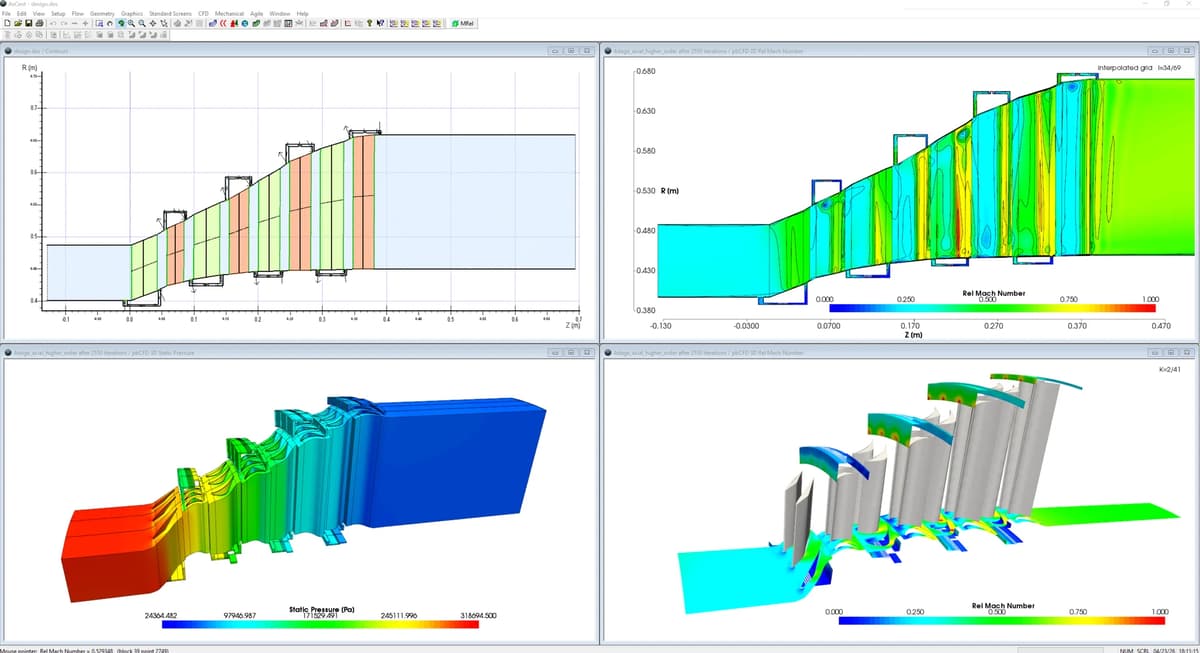
Version 2026.1 sharpens the system’s analytical edge with deeper secondary flow capabilities. Building on the 2025.2 release, engineers can now model leakage paths through standard, stepped or custom labyrinth seals for both radial and axial machines, leveraging Cadence Fidelity Fine Turbo and the pbCFD solver. Enhanced geometry handling in AxCent improves CFD convergence, translating to more reliable predictions of turbine performance and cooling effectiveness—critical factors for meeting emissions and durability standards.
On the manufacturing front, the MAX‑PAC module introduces spiral roughing and 3+2 undercutting techniques, allowing toolpaths to access hard‑to‑reach blade regions without excessive re‑positioning. Coupled with a unified process‑documentation interface, these tools help OEMs produce consistent, export‑ready reports in HTML or TXT, simplifying downstream quality audits. Together, the workflow automations and machining advances promise reduced lead times, lower material waste, and a smoother transition from virtual design to physical part, reinforcing Concepts NREC’s role as a catalyst for next‑generation turbine development.
Concepts NREC updates Agile Engineering Design System
Comments
Want to join the conversation?
Loading comments...