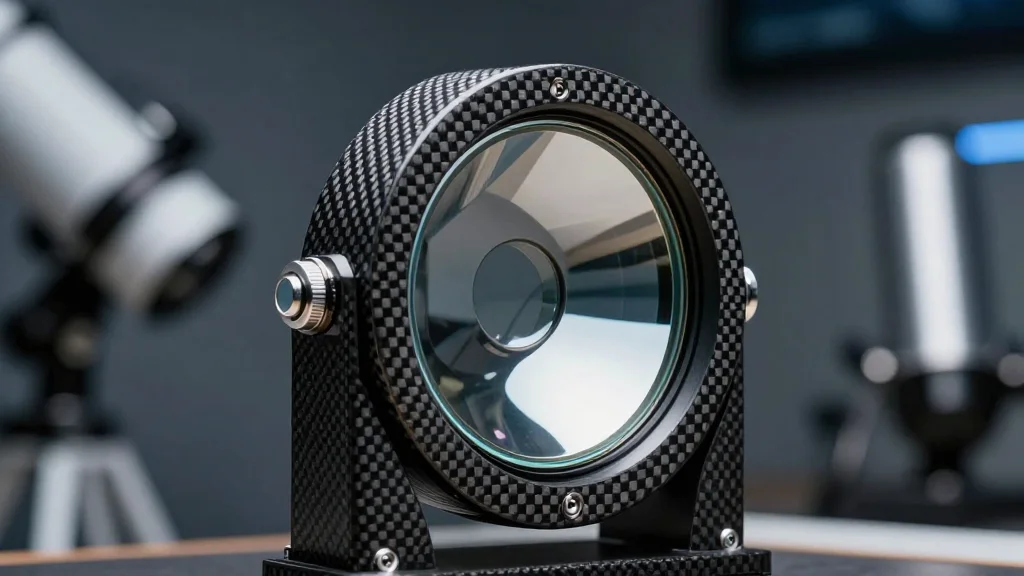
Connova Supplies High-Precision CFRP Components for the Giant Magellan Telescope
Companies Mentioned
Why It Matters
Connova’s breakthrough CFRP mounts enable the GMT to meet its stringent stability requirements, directly supporting next‑generation exoplanet research. The success highlights the strategic value of advanced composites for high‑precision scientific instruments.
Key Takeaways
- •Connova supplies CFRP frames for GMT's G‑CLEF spectrograph.
- •Frames maintain zero thermal expansion and full dimensional stability in vacuum.
- •Ultra‑high modulus fibers with INVAR36 ensure rigidity with minimal weight.
- •In‑house design, simulation, and testing validated by University of Bern.
- •Supports GMT’s 2030 launch and exoplanet life‑search scientific goals.
Pulse Analysis
The Giant Magellan Telescope (GMT) is slated for first light in 2030 and promises ten‑times the resolution of the Hubble Space Telescope. Its flagship instrument, the G‑CLEF spectrograph, must hold optical elements with nanometer‑scale stability to detect faint signals from Earth‑like exoplanets. Meeting that requirement calls for a mounting system that is both ultra‑rigid and immune to thermal drift. Swiss‑engineered Connova AG stepped in as the technology partner, delivering carbon‑fiber‑reinforced polymer (CFRP) holding frames that keep the optics perfectly aligned even under extreme vacuum and temperature swings.
Connova’s frames achieve near‑zero thermal expansion by combining ultra‑high modulus carbon fibers with a cyanate‑ester resin matrix and embedding INVAR36 inserts, a nickel‑iron alloy renowned for its minimal coefficient of expansion. The resulting composite delivers maximum stiffness at a fraction of the weight of traditional metal mounts, a critical factor for the telescope’s massive primary and secondary mirrors. Rigorous thermal‑cycle and vacuum testing, performed in collaboration with the University of Bern, confirmed 100 % dimensional stability and zero outgassing, meeting the stringent specifications required for long‑term astronomical observations.
The successful deployment of Connova’s CFRP mounts underscores a growing trend toward lightweight, high‑performance composites in precision scientific infrastructure. By delivering a solution that satisfies both mechanical rigidity and thermal neutrality, Connova reinforces its position as a Tier 1 supplier for aerospace, space, and high‑tech sectors. The GMT project, once operational, will enable researchers to probe biosignatures on distant worlds, potentially reshaping our understanding of life beyond Earth. As other next‑generation observatories adopt similar technologies, the demand for advanced composite manufacturing is set to accelerate, opening new market opportunities for firms with proven expertise.
Connova supplies high-precision CFRP components for the Giant Magellan Telescope
Comments
Want to join the conversation?
Loading comments...