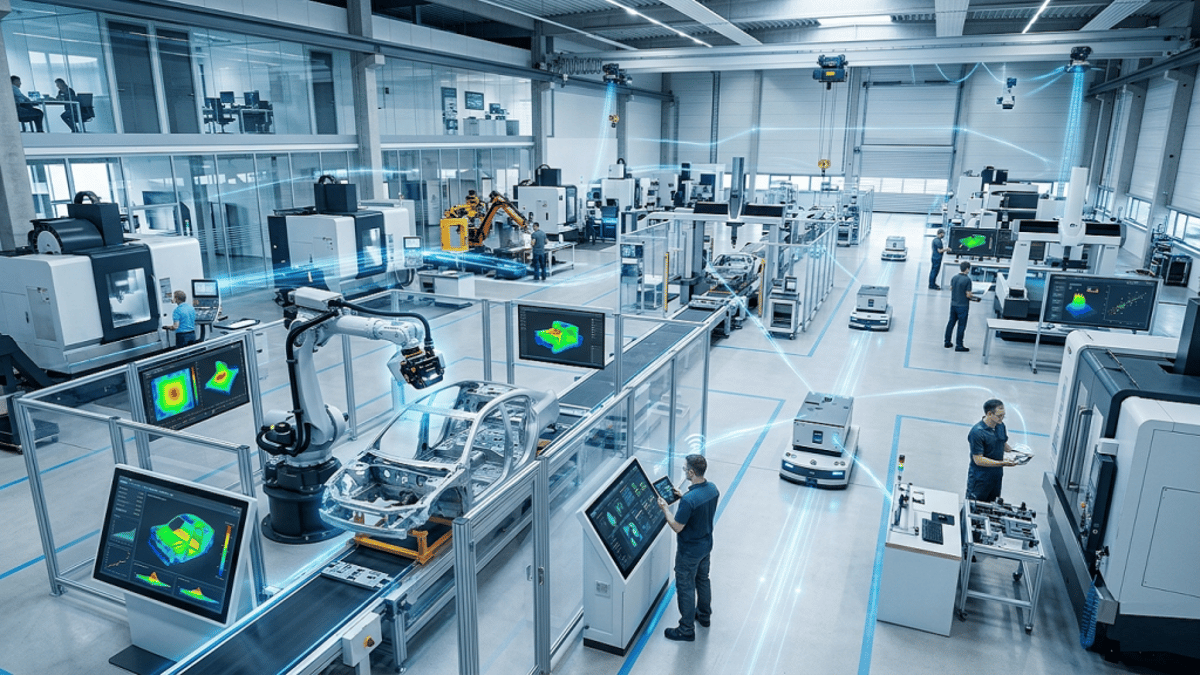
Driving Quality Through Manufacturing Intelligence
Why It Matters
Real‑time, predictive quality lowers waste and accelerates time‑to‑market, giving manufacturers a decisive cost and competitive edge. Companies that embed intelligence into quality become more resilient and can scale innovation faster.
Key Takeaways
- •Real-time metrology cuts scrap rates and production delays.
- •Predictive analytics enables defect prevention before occurrence.
- •AI-driven insights uncover hidden patterns beyond traditional statistics.
- •Integration hurdles persist with legacy equipment and data quality.
- •Digital twins and edge computing accelerate autonomous quality control.
Pulse Analysis
The transition to manufacturing intelligence reflects a broader industry push toward hyper‑efficient, data‑centric operations. As product complexity rises and tolerances tighten, traditional inspection methods can no longer keep pace. By aggregating dimensional data, machine states, and environmental variables through IIoT platforms, manufacturers gain a live pulse on quality, turning measurement into a strategic asset rather than a compliance checkpoint. This shift not only curtails material waste but also shortens cycle times, directly impacting profit margins.
Advanced analytics and AI are the engines that convert raw sensor streams into actionable foresight. Predictive models trained on historical and real‑time data can flag emerging tool wear, thermal drift, or subtle process shifts before they manifest as defects. When these insights feed back into production controls—often via edge computing nodes—the system can auto‑tune parameters, achieving a closed‑loop environment that operates with minimal human intervention. Digital twins further amplify this capability by simulating production scenarios, allowing engineers to test quality outcomes virtually and pre‑empt costly rework.
Despite the clear upside, adoption is uneven. Legacy CNC machines and proprietary data formats create integration bottlenecks, while inconsistent measurement standards threaten analytics reliability. Success therefore hinges on a holistic strategy: upgrading critical equipment, establishing robust data governance, and fostering a culture of data literacy across engineering and shop‑floor teams. Organizations that treat manufacturing intelligence as a strategic capability—not just a technology upgrade—will unlock continuous optimisation, positioning themselves at the forefront of the next industrial revolution.
Driving Quality Through Manufacturing Intelligence
Comments
Want to join the conversation?
Loading comments...