Easy EtherCAT Connectivity
Why It Matters
EtherCAT’s speed, determinism and plug‑and‑play wiring lower total‑cost of ownership while enabling tighter control loops, giving manufacturers a competitive edge in productivity and flexibility.
Key Takeaways
- •Sub‑millisecond deterministic cycle times boost motion‑control precision
- •Linear/ring topology allows daisy‑chain wiring without extra switches
- •Supports thousands of nodes; optimal performance with dozens
- •Cost‑effective EtherCAT stepper drives and VFDs rival servo options
Pulse Analysis
Industrial Ethernet adoption continues to outpace legacy fieldbus, driven by the need for faster, more flexible connectivity. While PROFINET and EtherNet/IP dominate the North American market, EtherCAT is carving out a niche thanks to its ultra‑low latency and deterministic performance, attributes prized in high‑speed motion control. Analysts note that EtherCAT now holds a solid share of the top‑three industrial Ethernet protocols, with expanding use across Europe, Asia and the United States, reflecting a broader shift toward Ethernet‑based automation architectures.
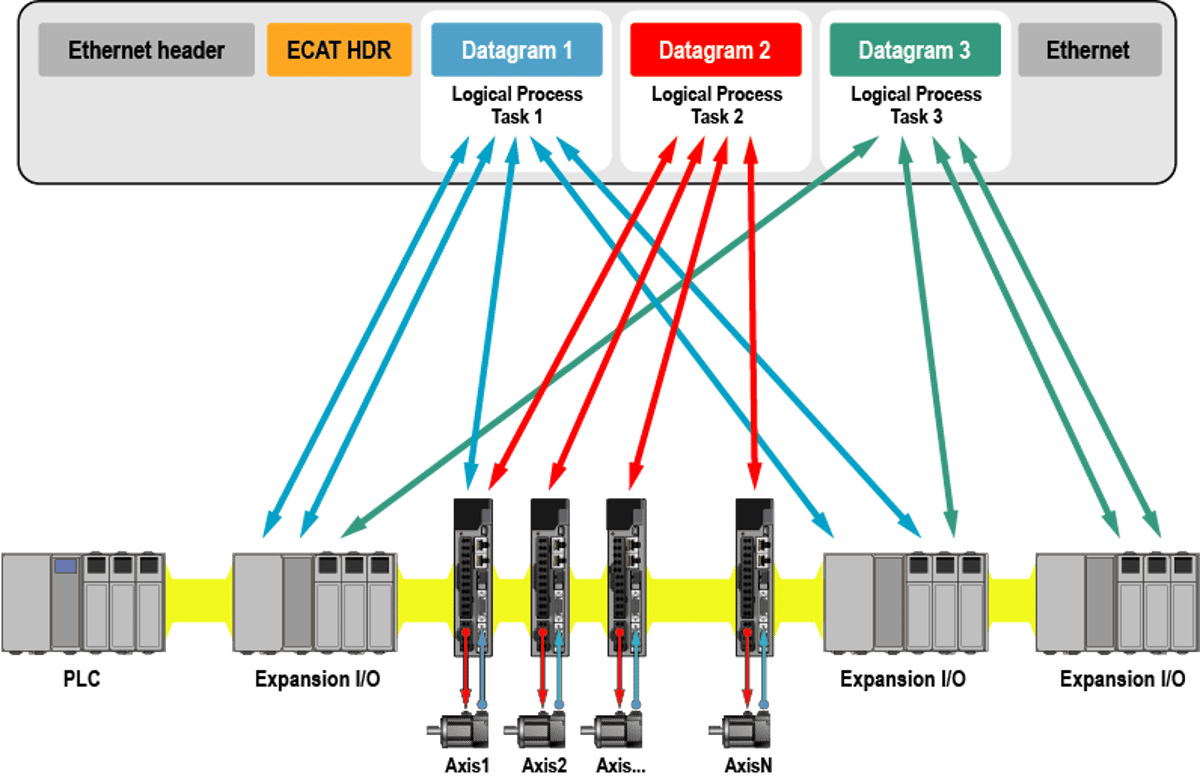
Technically, EtherCAT’s logical ring processing lets a single master inject a telegram that each slave reads, updates, and forwards in microseconds. This on‑the‑fly handling yields cycle times around 1,000 µs or less, enabling precise synchronization of multiple axes. The protocol’s flexibility in physical topologies—linear, ring, star or tree—combined with built‑in redundancy that can recover from a cable break in under 15 µs, makes it attractive for both new builds and retrofits where uptime is critical. Moreover, the ability to host thousands of nodes on a single network, while maintaining performance with a few dozen devices, offers scalability for complex machinery.
From a business perspective, the expanding catalog of EtherCAT‑enabled devices—especially affordable stepper drives, variable‑frequency drives and encoders—lowers the barrier to entry for manufacturers seeking high‑performance control without the premium cost of servo systems. The daisy‑chain wiring model eliminates the need for additional switches, cutting material expenses and installation labor, and simplifies troubleshooting and future upgrades. Integrated safety features such as Safe Torque Off further streamline emergency‑stop wiring. As a result, companies adopting EtherCAT can achieve faster time‑to‑market, reduced engineering overhead, and improved operational efficiency, positioning them competitively in an increasingly automated industrial landscape.
Easy EtherCAT Connectivity
Comments
Want to join the conversation?
Loading comments...