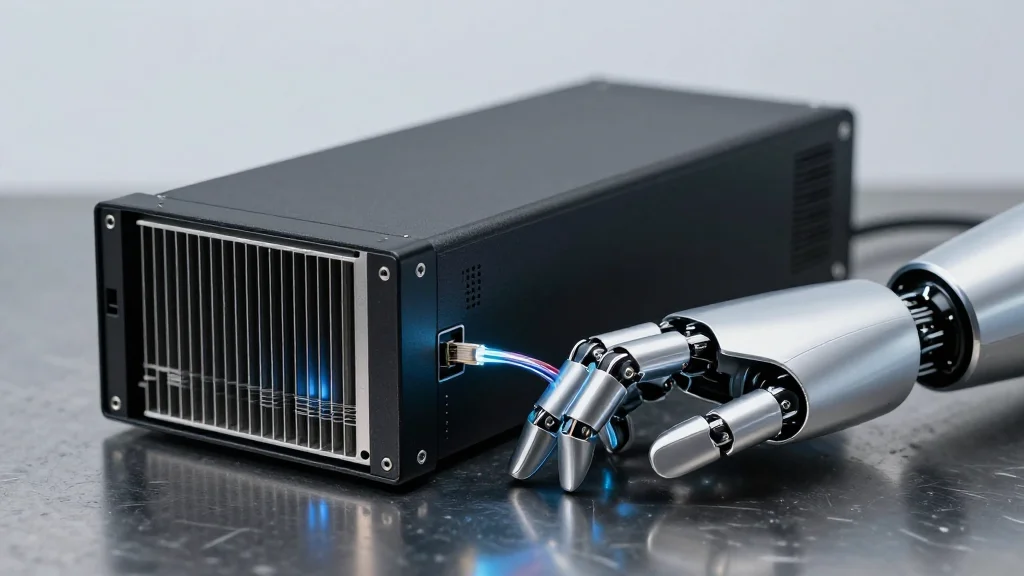
Edge‑Compute Platforms Become Essential for Tesla Optimus‑Powered Factories

Companies Mentioned
Why It Matters
Edge‑compute platforms are reshaping the economics of factory automation. By moving AI inference from the cloud to the shop floor, manufacturers can avoid costly line stoppages caused by network latency, improve worker safety, and unlock higher throughput for complex assembly operations. The technology also creates a new market for ruggedized compute hardware, prompting traditional data‑center vendors to adapt their product lines for industrial environments. The broader impact extends beyond individual plants. As more OEMs adopt edge‑centric AI, supply chains will need to accommodate faster data flows, tighter integration between hardware and software, and new standards for real‑time safety certification. This convergence could accelerate the rollout of fully autonomous factories, redefining competitive advantage in sectors ranging from automotive to consumer electronics.
Key Takeaways
- •Tesla Optimus deployment forces manufacturers to install on‑site edge‑compute clusters.
- •A 100 ms latency can cause positioning errors; sub‑10 ms response is now the target.
- •Up to 500 humanoid robots in a single plant generate parallel AI workloads comparable to self‑driving cars.
- •Model compression techniques can reduce power consumption by up to 75 % for edge vision tasks.
- •Manufacturers are budgeting for rugged GPU servers, low‑latency Ethernet fabrics, and redundant power systems.
Pulse Analysis
The emergence of edge‑compute as a cornerstone of industrial robotics signals a paradigm shift comparable to the transition from analog to digital control in the 1990s. Where PLCs once offered deterministic, low‑cost automation for repetitive tasks, today's AI‑driven robots demand a compute fabric that can process terabytes of sensor data in real time. This requirement creates a new competitive frontier: firms that can deliver rugged, low‑latency hardware at scale will capture a sizable share of the $150 billion industrial automation market.
Tesla's Optimus strategy illustrates the upside of vertical integration. By designing both the robot and its compute stack, Tesla can tightly couple hardware and software, reducing latency and simplifying system validation. However, this also raises barriers for third‑party vendors who must meet stringent durability and performance specs to compete. Traditional data‑center players like NVIDIA and Intel are already rolling out industrial‑grade GPUs and AI accelerators, but they will need to partner with system integrators familiar with factory floor constraints.
Looking forward, the race will likely focus on three axes: latency, power efficiency, and resilience. Edge chips that can deliver sub‑5‑millisecond inference while operating in dusty, high‑vibration environments will become the de‑facto standard. Companies that invest early in modular, upgradable edge platforms will not only reduce total cost of ownership but also future‑proof their factories against the rapid evolution of AI models. In the next two to three years, we can expect a wave of capital spending announcements as manufacturers retrofit existing lines and design new facilities around edge‑first architectures, cementing edge compute as the backbone of next‑generation manufacturing.
Edge‑Compute Platforms Become Essential for Tesla Optimus‑Powered Factories
Comments
Want to join the conversation?
Loading comments...