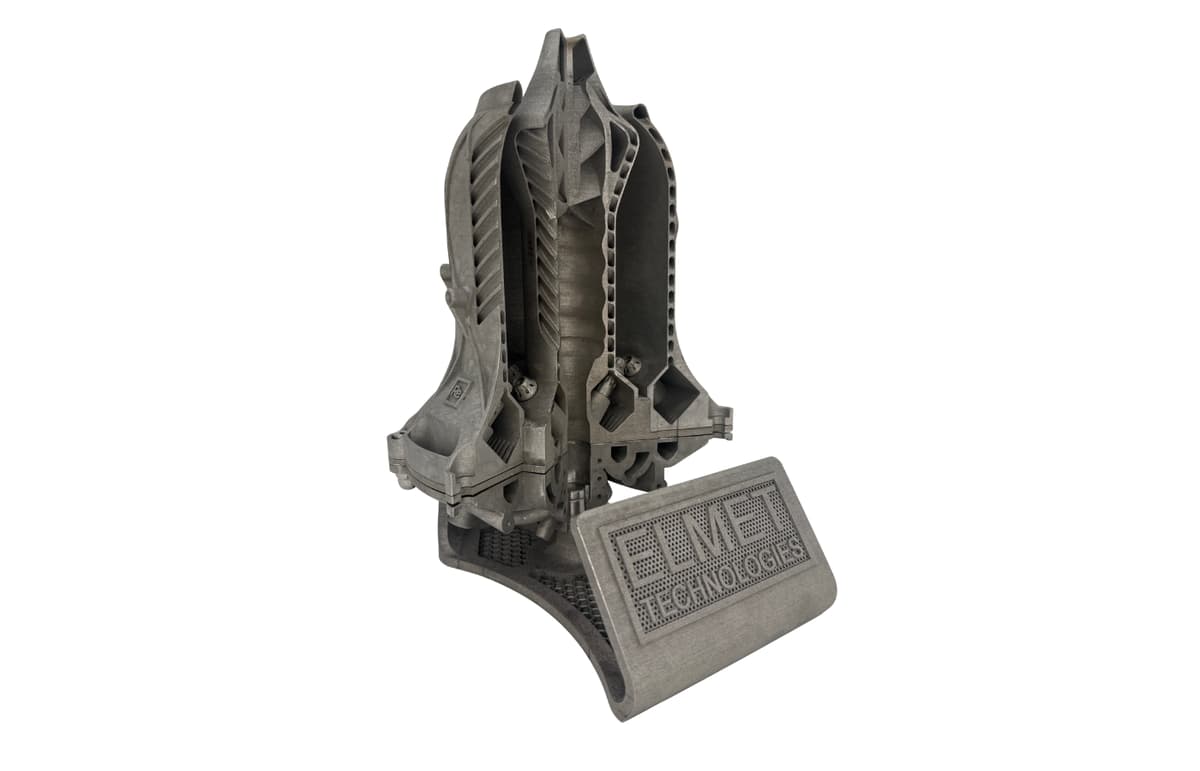
Elmet Technologies Granted US Patent for 'Fabrication of Metallic Parts by Additive Manufacturing' Technology
Why It Matters
The technology resolves long‑standing powder‑flow challenges for refractory metals, unlocking high‑performance, complex tungsten components for critical aerospace and defence markets.
Key Takeaways
- •Sixth U.S. patent strengthens Elmet's additive manufacturing IP portfolio
- •Dry powder bed uses spherical composite particles for binder‑jet printing
- •Incorporates tungsten heavy alloys with nickel, iron, copper additives
- •Achieves ASTM B777 Class 1 density, hardness, and tensile strength
- •Supports both binder‑jet and directed energy deposition manufacturing routes
Pulse Analysis
Additive manufacturing has reshaped how metal components are produced, but refractory metals such as tungsten remain difficult to process because their high melting points and brittleness hinder powder flowability and sintering. Traditional atomization methods generate irregular particles that clog powder‑bed recoaters and lead to inconsistent part density. As a result, manufacturers have relied on costly subtractive techniques or limited design complexity for critical aerospace and defence parts. Overcoming these material‑science barriers is essential for unlocking the weight‑saving and performance advantages that tungsten‑based alloys can deliver in extreme‑temperature environments.
Elmet Technologies’ newly granted U.S. Patent No. 12,571,080 tackles the powder‑flow problem by employing a dry‑bed of substantially spherical composite particles created through advanced spray drying followed by optional plasma densification. The process yields particles with Hall flow rates between 1 and 25 seconds per 50 grams, ensuring uniform spreading for binder‑jet printing and directed‑energy deposition. By embedding tungsten grains in a matrix of lower‑melting‑point transition metals—nickel, iron, copper, cobalt, or manganese—the alloy maintains high purity while allowing controlled densification and minimal shrinkage during sintering, meeting ASTM B777 Class 1 specifications.
The patent bolsters Elmet’s growing portfolio of additive‑manufacturing IP, positioning the company to capture a niche market where high‑density, high‑strength components are mission‑critical. Aerospace engine nozzles, radiation shields, and defence armor can now be fabricated with complex geometries that were previously impractical, reducing part count and lifecycle costs. Moreover, the domestically owned production line aligns with U.S. strategic goals for secure supply chains of critical materials. As the industry seeks to scale refractory‑metal printing, Elmet’s technology may set a new benchmark for performance, prompting competitors to invest in similar powder‑engineering solutions.
Elmet Technologies granted US patent for 'Fabrication of Metallic parts by Additive Manufacturing' technology
Comments
Want to join the conversation?
Loading comments...