Enhancing Industrial Automation: Why Compact Mini PCs Are Quietly Becoming the Default Choice for Robotic Controllers
Companies Mentioned
Why It Matters
Compact industrial mini PCs reduce footprint and failure points while delivering the compute power needed for modern edge workloads, accelerating the shift toward decentralized, resilient factory automation.
Key Takeaways
- •Mini PCs replace bulky industrial PCs in tight control cabinets
- •Dual Ethernet separates real‑time control traffic from IT data streams
- •Up to 64 GB RAM supports expanding vision and AI workloads
- •Aluminum chassis ensures 24/7 operation in harsh factory conditions
- •Triple display outputs enable comprehensive on‑floor monitoring
Pulse Analysis
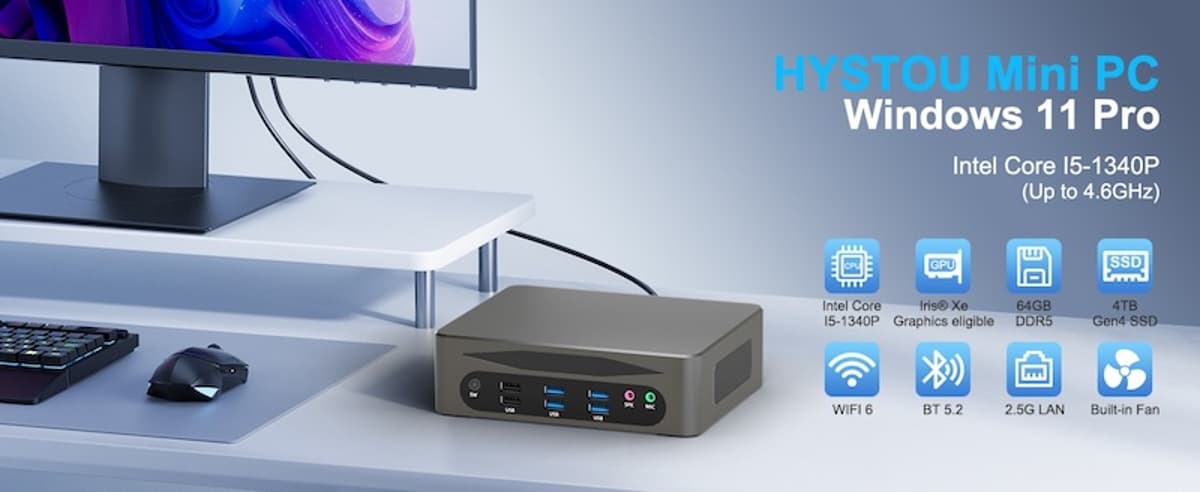
The rise of edge computing in manufacturing is reshaping how factories handle control logic. Rather than routing sensor data to a central server, engineers are placing compute resources directly next to the equipment. Compact industrial mini PCs, such as the Hystou M9, embody this shift by delivering desktop‑class performance in a footprint that fits inside existing control cabinets. The space savings reduce wiring complexity and allow retrofits without major layout changes, while the solid‑state design lowers power consumption compared with legacy rack‑mounted PCs.
Beyond size, the M9’s hardware choices address the demanding workloads of modern automation. Intel’s 12th‑ and 13th‑generation Core i5/i7 CPUs provide enough cores for real‑time motion control, vision inspection, and lightweight AI inference without sacrificing latency. Dual Ethernet ports—2.5 Gbps for time‑critical sensor traffic and 1 Gbps for enterprise monitoring—create a logical separation that protects control loops from network congestion. With up to 64 GB of DDR4 memory and an aluminum alloy chassis, the system can sustain 24/7 operation, dissipate heat efficiently, and scale as data‑intensive applications grow.
The practical benefits are translating into faster adoption across sectors ranging from automotive assembly to food processing. Companies report lower total cost of ownership because a single mini PC can replace multiple legacy boxes, cutting both hardware spend and maintenance overhead. Moreover, the compact form factor eases scaling; adding a new robotic cell often means installing another M9 rather than redesigning the entire control cabinet. As the Industrial Internet of Things matures, vendors that combine high‑performance CPUs, robust networking, and rugged thermal design are poised to become the default platform for edge‑centric automation strategies.
Enhancing Industrial Automation: Why Compact Mini PCs Are Quietly Becoming the Default Choice for Robotic Controllers
Comments
Want to join the conversation?
Loading comments...