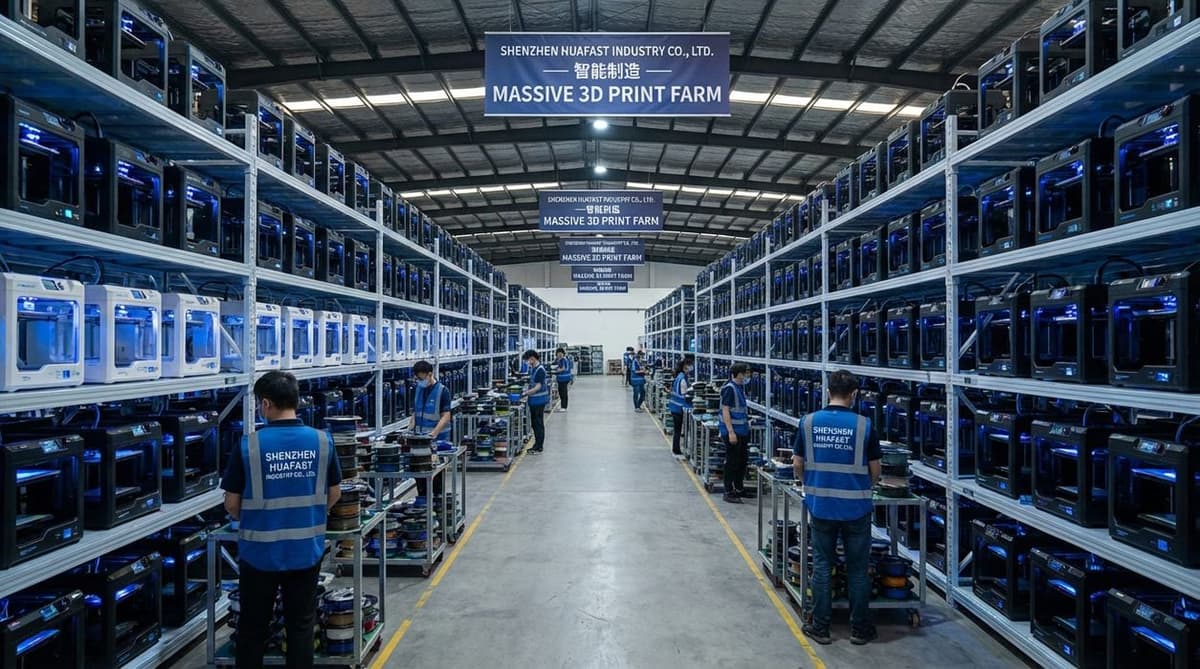
Enormous 3D Print Farm in China Demonstrates Ultra High-Volume Additive Manufacturing
•February 26, 2026
0
Why It Matters
The operation proves that large‑scale 3D printing can rival traditional manufacturing in volume, reshaping supply chains and enabling on‑demand, tool‑free production. It signals a strategic shift for industries seeking rapid, customizable, low‑tooling‑cost manufacturing at scale.
Key Takeaways
- •5,000 printers operate in single Shenzhen facility
- •Produced 40,000 ornaments within one week
- •Capacity could reach 10,000 printers by year‑end
- •Potential daily output 160,000 parts at 3‑hour cycle
- •Signals shift from prototyping to mass‑custom manufacturing
Pulse Analysis
Additive manufacturing has long been associated with low‑volume prototyping, but the emergence of ultra‑large print farms is redefining that narrative. In China’s Shenzhen hub—home to leading printer makers like Bambu Lab—Huafast Industry has built a vertically integrated line of 5,000 desktop‑class printers. By arranging machines on multi‑tier racks, the company achieves a kilometer‑long production corridor that can churn out tens of thousands of parts in days, rivaling conventional injection‑molding runs without the need for expensive tooling or molds.
The operational metrics are striking: a single week saw 40,000 ornamental items completed, and theoretical calculations suggest a daily throughput of 160,000 components when each printer completes a four‑part batch in three hours. Scaling to 10,000 printers would push weekly output into the multi‑million range, positioning the farm as a true “anything factory.” This model leverages the flexibility of additive processes—instant design changes, low inventory—and couples it with economies of scale traditionally reserved for mass‑production methods, potentially lowering per‑part costs while maintaining customization.
For the broader manufacturing ecosystem, such farms could compress supply chains, reduce lead times, and diminish reliance on overseas tooling hubs. Companies in consumer goods, automotive, and aerospace may adopt similar high‑density printer arrays to meet volatile demand without sacrificing design freedom. However, challenges remain in material handling, quality assurance, and energy consumption. As more firms explore this approach, the competitive landscape will likely shift toward firms that can integrate large‑scale additive capacity with robust digital workflow management, heralding a new era of distributed, on‑demand manufacturing.
Enormous 3D Print Farm in China Demonstrates Ultra High-Volume Additive Manufacturing
0
Comments
Want to join the conversation?
Loading comments...