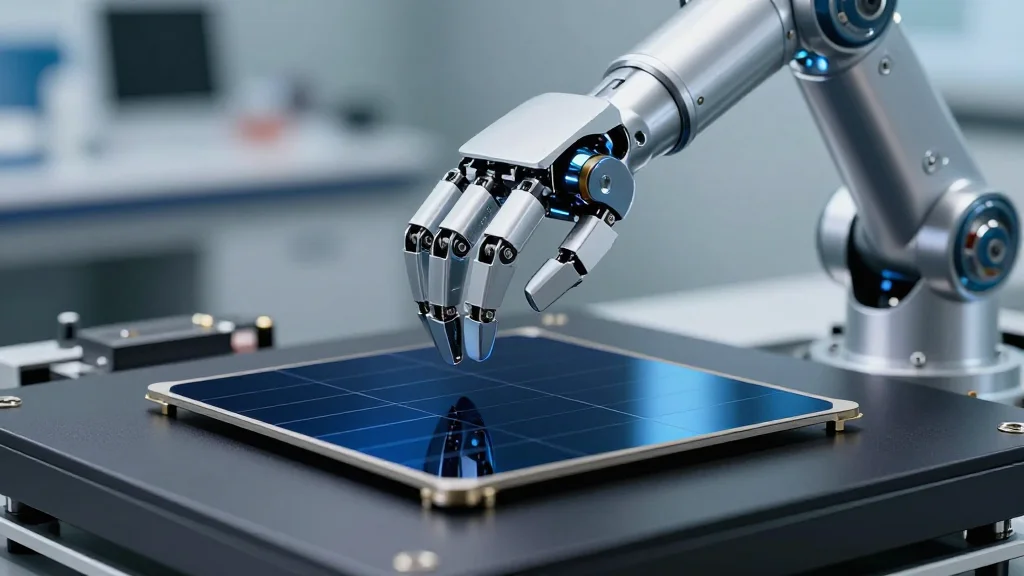
Fabricating Perovskite Solar Cells with Robotic Boxes
Why It Matters
The breakthrough dramatically accelerates perovskite research, shrinking development cycles and moving the technology closer to commercial viability in the rapidly expanding solar market.
Key Takeaways
- •AI-driven platform fabricated 50,764 perovskite cells autonomously.
- •Record efficiency reached 27% (certified 26.5%).
- •System integrates 11 robotic boxes, 101 functional units, 4,300 parameters.
- •Four-stage workflow lifts efficiency from 0% to 27% using additives.
- •Recipe language model draws on 60,000 papers to guide recipes.
Pulse Analysis
Perovskite solar cells have long promised higher efficiencies and lower production costs than traditional silicon, but their rapid material degradation and complex fabrication have hampered scale‑up. Researchers have relied on manual trial‑and‑error, which is time‑consuming and prone to inconsistencies. By embedding artificial intelligence into the experimental loop, the new platform eliminates human bottlenecks, enabling systematic exploration of thousands of compositional variations while maintaining precise control over each processing step.
The core of the system is a recipe language model that ingests data from roughly 60,000 scholarly articles and continuously learns from the 50,764 devices it fabricates. Eleven robotic boxes execute tasks ranging from chemical storage to spin‑coating and laser processing, all synchronized through a seven‑layer AI architecture. This closed‑loop approach not only generates a digital twin of each experiment but also feeds real‑time performance metrics back into the model, allowing it to refine subsequent recipes. The result is a rapid, data‑rich pathway from hypothesis to high‑efficiency device.
For the solar industry, the implications are profound. Achieving 27% efficiency in a fully automated, reproducible workflow shortens the R&D timeline and reduces the cost per experiment, making perovskite technology more attractive to investors and manufacturers. The modular nature of the robotic boxes means the platform can be adapted to other thin‑film photovoltaics or emerging materials, potentially reshaping how advanced energy devices are developed. As the market seeks greener, cheaper power sources, such AI‑robotic integration could be the catalyst that brings perovskite panels from the lab to rooftops worldwide.
Fabricating perovskite solar cells with robotic boxes
Comments
Want to join the conversation?
Loading comments...