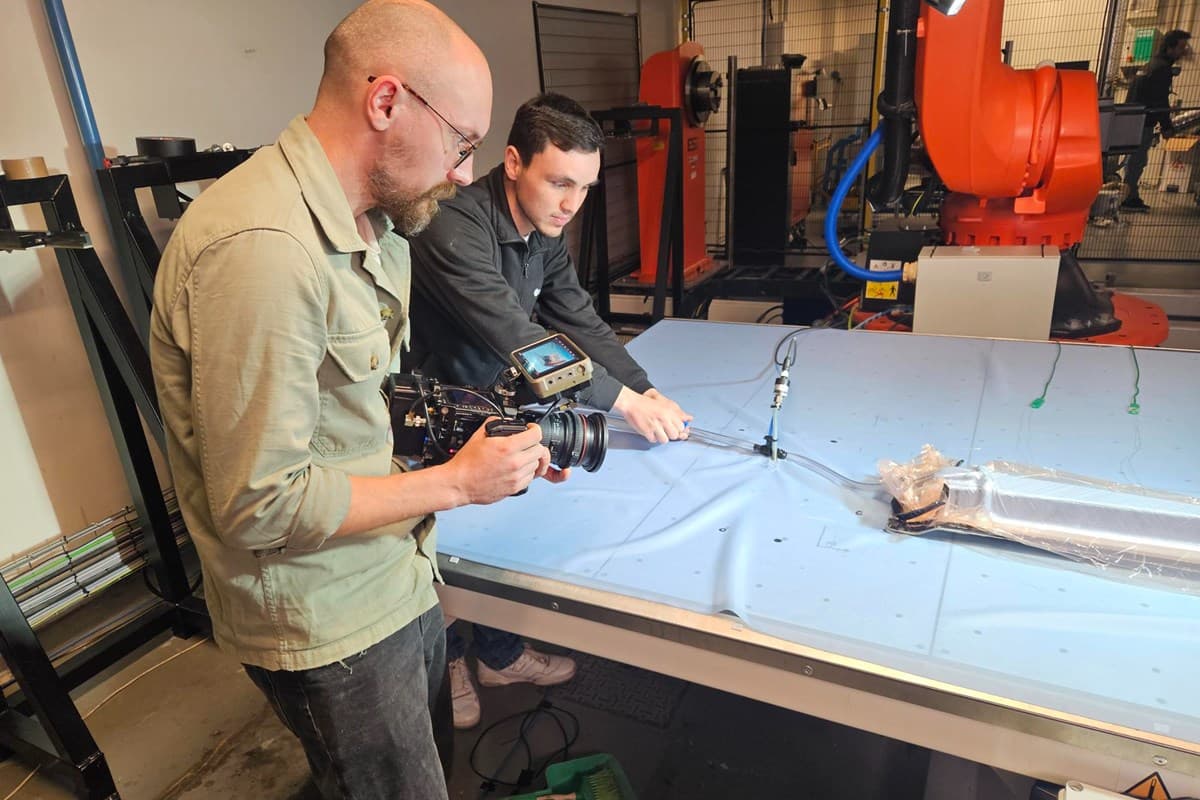
FLASH-COMP Project Validates Integration Readiness for More Intelligent, Defect-Free LRI Approach
•March 4, 2026
0
Why It Matters
The breakthrough demonstrates that digital‑twin‑driven LRI can reliably eliminate defects, reducing cost and waste for high‑value composite industries. It de‑risks adoption of advanced sensing and AI‑based decision support in production environments.
Key Takeaways
- •Physical test bed validates sensor‑to‑simulation data flow.
- •Modular rig transitions from robot‑assisted to fixed industrial setup.
- •Integrated optical, thermal, process sensors achieve coherent data acquisition.
- •Pre‑industrial trials confirm digital twin accuracy for LRI processes.
- •Project moves to industrial demo with Azimut Benetti yacht builder.
Pulse Analysis
Composite manufacturers have long grappled with the variability of liquid resin infusion, where uneven flow can cause costly rework or scrap. By embedding a suite of heterogeneous sensors—optical, thermal and process—directly into the infusion line, FLASH-COMP creates a live digital twin that mirrors the physical process in real time. This data‑rich environment enables predictive analytics and rapid simulation feedback, turning a traditionally reactive workflow into a proactive, defect‑free operation.
The test bed’s architecture balances flexibility and industrial relevance. Early stages employed robot‑assisted sensor placement, allowing rapid reconfiguration for experimental layouts. As validation progressed, the system evolved into a mechanically stable rig with fixed mounting points, mirroring the constraints of a production line while preserving the validated data pipelines. Localized data acquisition and preprocessing reduce latency, ensuring that simulation outputs and decision‑support recommendations are delivered within the process window, a critical factor for high‑precision composite parts.
With pre‑industrial validation complete, FLASH‑COMP is poised to scale its approach at Azimut Benetti, a leading yacht builder seeking zero‑defect composites. Successful industrial demonstration will showcase tangible cost savings, waste reduction and shorter time‑to‑market for complex composite structures. The broader industry—aviation, automotive and wind energy—stands to benefit from a proven, interoperable framework that integrates sensing, simulation and decision support, accelerating the shift toward sustainable, high‑performance manufacturing.
FLASH-COMP project validates integration readiness for more intelligent, defect-free LRI approach
0
Comments
Want to join the conversation?
Loading comments...