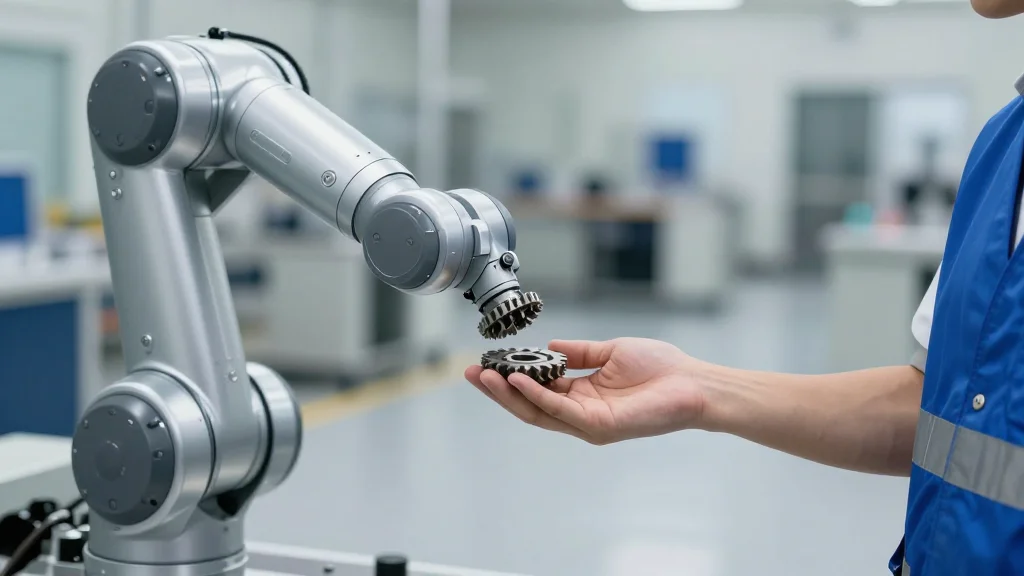
Flex and Teradyne Deepen Alliance to Speed Intelligent Automation in Factories Worldwide

Companies Mentioned
Why It Matters
The expanded Flex‑Teradyne alliance tackles two critical challenges facing manufacturers: the need for rapid automation deployment and the integration of AI to handle complex, variable production processes. By combining real‑world testing with component manufacturing, the partnership reduces the time and cost required to bring advanced robotics to market, potentially reshaping how factories achieve flexibility and resilience. For the broader manufacturing ecosystem, the collaboration signals a shift toward tighter integration between hardware producers and end‑users. As more firms adopt AI‑enhanced cobots and AMRs, supply‑chain dynamics, workforce training and capital allocation will evolve, prompting competitors to seek similar joint‑development models to stay competitive.
Key Takeaways
- •Flex will install Universal Robots cobots and MiR autonomous mobile robots in its own plants.
- •Flex will manufacture key components for UR robots used by Teradyne’s external customers.
- •The partnership creates a feedback loop that accelerates validation and scaling of intelligent automation.
- •Teradyne is embedding physical AI technologies into its robots to improve adaptability and efficiency.
- •Both companies aim to expand deployments globally, targeting sectors such as electronics, semiconductor and automotive manufacturing.
Pulse Analysis
The Flex‑Teradyne partnership reflects a broader industry trend where automation vendors are moving beyond pure sales models toward collaborative ecosystems that embed hardware in real production settings. Historically, robotics firms have struggled to prove ROI at scale because pilot projects often remain isolated. By turning Flex’s factories into living laboratories, the two companies can demonstrate tangible benefits—higher throughput, lower defect rates, and faster changeover times—directly to prospective buyers.
From a competitive standpoint, the alliance pits the duo against larger integrated players like Siemens and ABB, which already offer end‑to‑end automation stacks. However, Flex’s deep manufacturing footprint and Teradyne’s AI‑focused robotics give them a differentiated value proposition: a rapid‑feedback loop that can iterate hardware and software in months rather than years. This could force incumbents to accelerate their own co‑development initiatives or risk losing market share in fast‑growing segments such as flexible electronics and high‑mix, low‑volume production.
Looking forward, the success of this partnership will hinge on the ability to translate pilot successes into standardized, repeatable solutions that can be sold at scale. If Flex and Teradyne can demonstrate consistent performance gains across multiple sites, they may set a new benchmark for intelligent automation, prompting a wave of similar collaborations across the manufacturing sector. The next 12 to 18 months will be critical as the companies roll out additional deployments and begin to quantify cost savings and productivity lifts for their customers.
Flex and Teradyne deepen alliance to speed intelligent automation in factories worldwide
Comments
Want to join the conversation?
Loading comments...