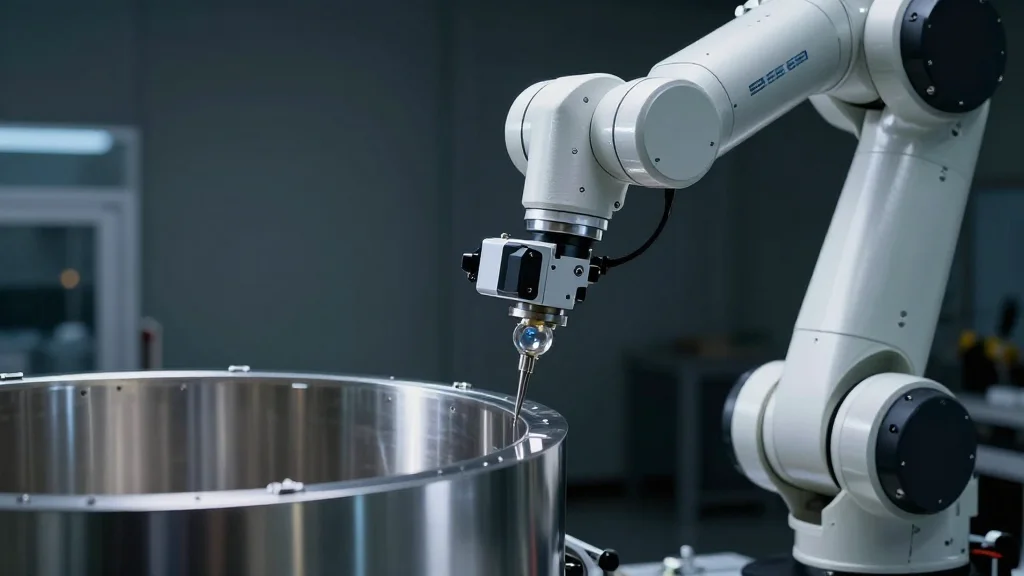
Giving Fusion Robots Eyes and Touch – Metrology Technologies Powering ITER’s In-Vessel Assembly
Why It Matters
Remote handling is critical for building and maintaining ITER, ensuring safety and precision as radiation levels rise. Success here sets a benchmark for future commercial fusion plants and advances heavy‑duty robotics across industries.
Key Takeaways
- •ITER's "Godzilla" robot uses vision for 0.06 mm positioning accuracy.
- •Force‑torque sensors from HBK give robots tactile feedback during heavy lifts.
- •Long‑reach arms can handle up to 9‑tonne divertor cassettes.
- •Collaboration spans universities, startups, and industrial partners to create fusion‑grade robotics.
- •Remote handling essential as radiation will soon block human access inside tokamak.
Pulse Analysis
ITER’s in‑vessel assembly program illustrates how fusion energy projects are driving robotics beyond conventional limits. The tokamak’s cramped, radiation‑filled interior forces engineers to replace human hands with machines that can reach through narrow ports, lift components weighing up to nine tonnes, and place them with sub‑millimetre accuracy. By integrating machine‑vision that reads laser‑etched markers, operators can correct arm deflection in real time, achieving positioning tolerances finer than a human hair. This visual feedback, combined with force‑torque sensors from HBK, gives the robots a sense of touch, preventing collisions and stabilizing loads as they extend deep into the vessel.
The technology stack emerging from ITER blends academic research, niche startups and established industrial suppliers. Finnish spin‑off Operview adapts university‑originated vision algorithms for vacuum‑compatible cameras, while German metrology firm HBK hardens strain‑gauge sensors against neutron radiation and seismic shocks. These collaborations accelerate the translation of prototype concepts into field‑ready hardware, creating a supply chain for fusion‑specific robotics that could spill over into aerospace, nuclear decommissioning and heavy manufacturing where remote precision is paramount.
Beyond the immediate engineering challenge, ITER’s robotic breakthroughs signal a paradigm shift for the broader fusion industry. As the project moves toward high‑power operation, the reliance on remote handling will become a design norm for commercial reactors, reducing operational downtime and protecting personnel. Moreover, the heavy‑duty, radiation‑tolerant robots being refined today may open new markets for manufacturers seeking to service extreme environments, positioning ITER as a catalyst for a next generation of industrial automation.
Giving Fusion Robots Eyes and Touch – Metrology Technologies Powering ITER’s In-Vessel Assembly
Comments
Want to join the conversation?
Loading comments...