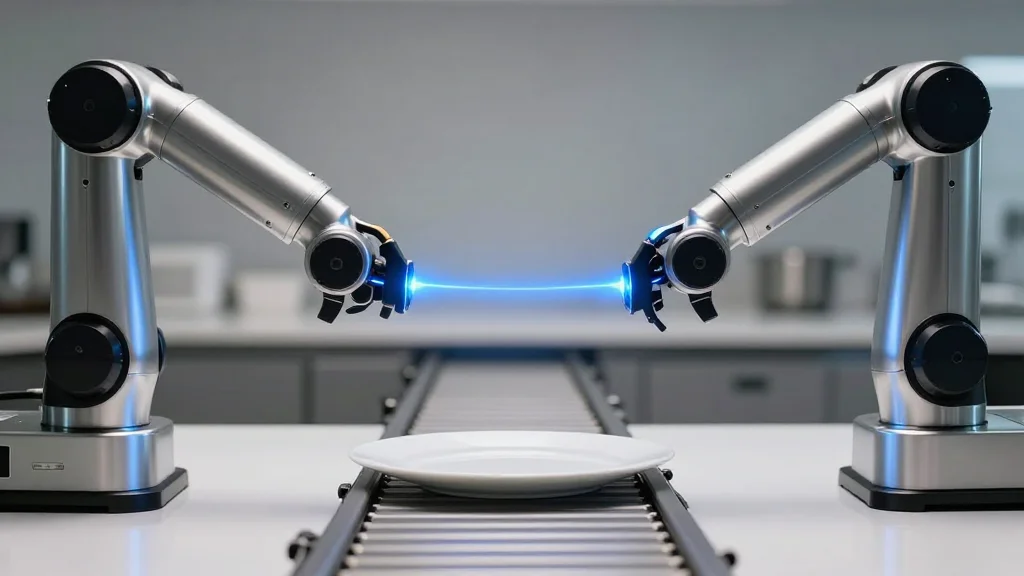
How Chef Robots Coordinate to Maximize Throughput
Companies Mentioned

Why It Matters
R2R communication directly lifts production throughput and reliability, giving food manufacturers a scalable automation layer without costly infrastructure upgrades.
Key Takeaways
- •R2R lets robots share tray data in real time.
- •Increases line throughput up to 150 trays per minute.
- •Reduces spillage and missed trays across ingredient types.
- •No extra infrastructure; built‑in wireless radios suffice.
- •Scales easily across U.S., Canada, U.K. facilities.
Pulse Analysis
High‑speed food assembly lines have long wrestled with the coordination problem: multiple robots must know exactly where a moving tray is to deposit ingredients without error. Traditional solutions rely on centralized controllers or vision systems that can lag behind rapid conveyor motion, leading to bottlenecks and waste. By embedding a lightweight, peer‑to‑peer wireless protocol into each robot, Chef Robotics sidesteps these constraints, enabling each unit to act both independently and as part of a synchronized swarm. This approach mirrors trends in industrial IoT, where edge devices share state to improve overall system resilience.
The R2R capability leverages each robot’s existing perception stack, broadcasting tray coordinates and orientation as soon as the upstream unit completes a deposit. Downstream robots receive this feed instantly, adjusting their motion plans to match the exact tray trajectory. The result is a dramatic reduction in latency—robots can react to fast‑moving trays in milliseconds—while maintaining ingredient‑agnostic operation, since the system tracks trays rather than specific foods. Because the communication layer is baked into the hardware, manufacturers avoid additional networking gear, simplifying retrofits and new line builds.
From a market perspective, the technology strengthens Chef’s robotics‑as‑a‑service offering, positioning the company as a turnkey solution for scaling automation in the food sector. With throughput potential of 150 trays per minute, facilities can meet rising demand for ready‑to‑eat meals without expanding labor pools. The cross‑regional rollout in North America and the U.K. also signals confidence in regulatory compliance and supply‑chain readiness. As competitors chase similar swarm‑robotics capabilities, Chef’s early mover advantage could set a new benchmark for coordinated, high‑speed food manufacturing.
How Chef Robots Coordinate to Maximize Throughput
Comments
Want to join the conversation?
Loading comments...