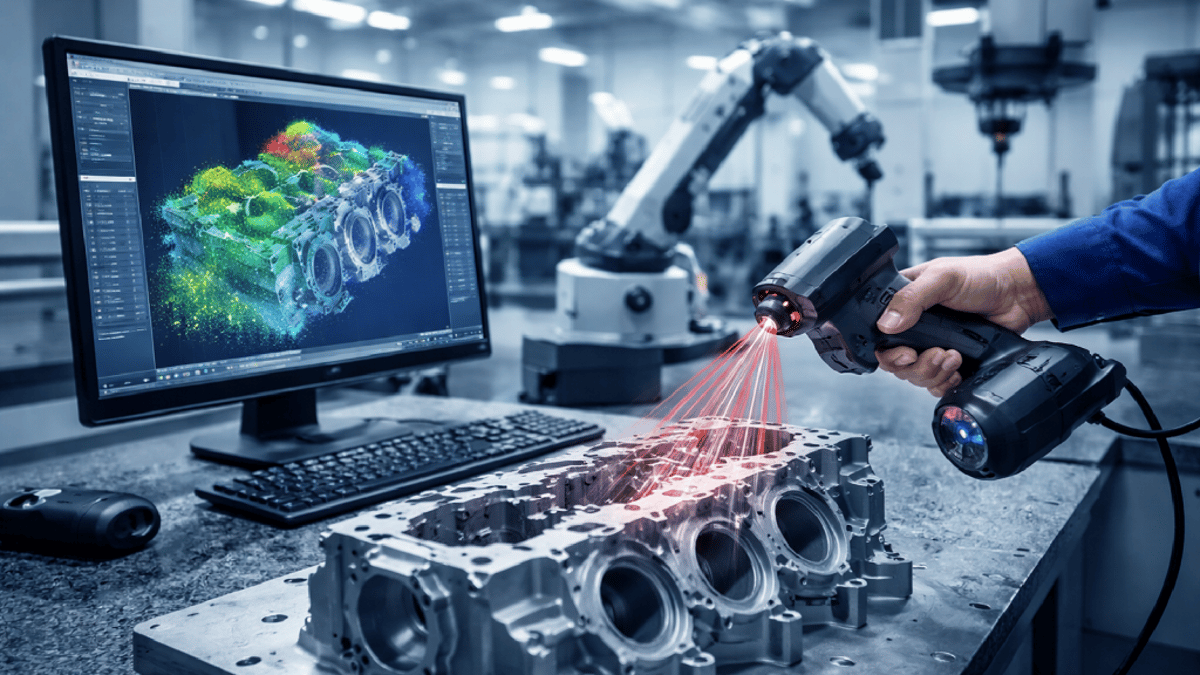
How Point Clouds Are Revolutionizing Manufacturing Quality Control
Why It Matters
Full‑field, data‑rich inspection transforms quality control from a reactive checkpoint into a proactive, closed‑loop process, cutting waste and accelerating time‑to‑market for high‑mix, high‑volume manufacturers.
Key Takeaways
- •Point clouds capture entire part surfaces in seconds
- •Inline scanning cells enable real‑time defect detection
- •AI analyzes point‑cloud data for micro‑cracks and wear
- •Digital twins use as‑built scans for adaptive machining
- •Hybrid workflows blend CMM precision with full‑field coverage
Pulse Analysis
The adoption of point‑cloud technology marks a fundamental shift in metrology, moving away from discrete, operator‑driven measurements toward comprehensive, sensor‑driven data capture. High‑speed laser and structured‑light scanners now generate dense 3‑D point sets at rates of millions of points per second, allowing manufacturers to digitize complex geometries—such as turbine blades or car chassis—in a matter of seconds. This full‑field approach eliminates the sampling bias inherent in traditional CMMs, delivering micron‑level surface fidelity and enabling engineers to extract any dimension post‑scan, which dramatically reduces inspection bottlenecks and supports rapid design iterations.
Beyond raw measurement, point clouds serve as the backbone of digital‑twin ecosystems. By continuously feeding as‑built data into virtual models, manufacturers can close the loop between design intent and production reality. Deviations detected in real time are routed to CNC controllers for adaptive machining, while analytics platforms flag systematic errors for process optimization. When coupled with machine‑learning algorithms, the rich spatial information uncovers subtle defects—micro‑cracks, surface waviness, or material porosity—that would escape visual inspection, and it fuels predictive maintenance schedules that minimize unexpected downtime.
The primary hurdle remains the sheer volume of data; a single scan can contain billions of points, demanding robust storage, GPU‑accelerated processing, and standardized data pipelines. Recent advances in edge computing, cloud‑based point‑cloud services, and AI‑assisted filtering are mitigating these challenges, making autonomous inspection cells feasible on the shop floor. As standards converge and software interoperability improves, point‑cloud‑driven quality control is poised to become the default, delivering higher yields, lower scrap rates, and a competitive edge for manufacturers navigating the Industry 4.0 landscape.
How Point Clouds Are Revolutionizing Manufacturing Quality Control
Comments
Want to join the conversation?
Loading comments...