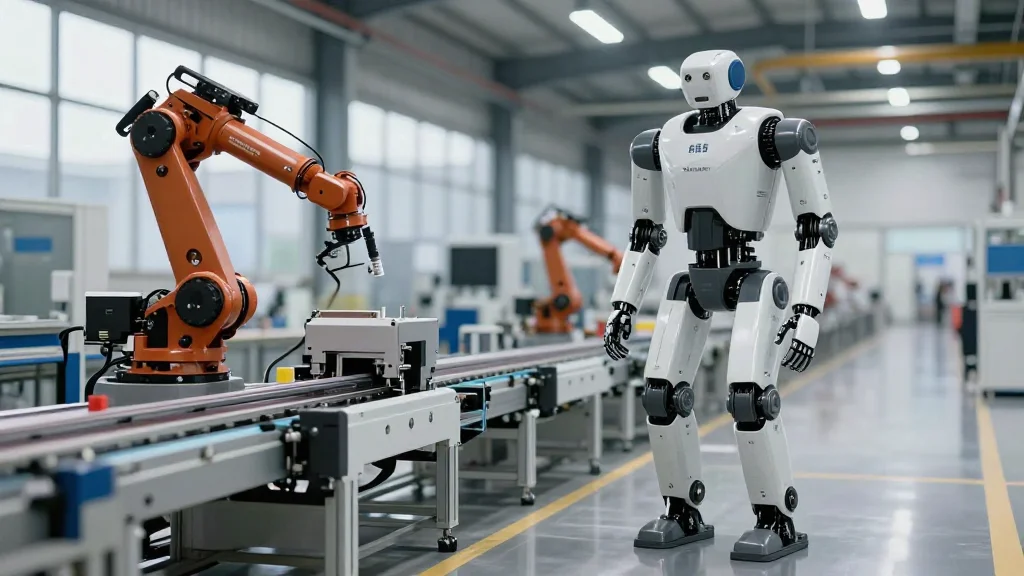
Hyundai Motor Group Fast‑tracks Atlas Humanoid Robot Production in Georgia

Companies Mentioned


Why It Matters
Hyundai’s accelerated Atlas production marks a watershed moment for manufacturing automation, demonstrating that large‑scale humanoid robots can move from prototype to production line. By embedding AI‑controlled robots directly into its factories, Hyundai aims to cut cycle times, improve defect detection and reduce reliance on manual labor—pressures that have intensified amid global workforce shortages. The broader supply‑chain moves, including a dedicated robotics parts office and a global trade strategy unit, address two historic bottlenecks for advanced robotics: component scarcity and geopolitical risk. If successful, Hyundai’s model could become a template for other OEMs seeking to build resilient, software‑centric factories that can adapt quickly to market fluctuations and regulatory changes.
Key Takeaways
- •Hyundai accelerates mass production of Atlas humanoid robots at HMGMA in Georgia.
- •New Software Defined Factory (SDF) division created, led by Alpesh Patel.
- •Robotics Parts Procurement Office established to source actuators and grippers, targeting 350,000 units annually.
- •Georgia plant employs ~1,700 workers and runs >1,000 existing robots, serving as a testbed for AI integration.
- •Global Trade Strategy Office launched to mitigate tariff and supply‑chain risks.
Pulse Analysis
Hyundai’s strategy reflects a shift from incremental automation to a holistic, software‑first manufacturing paradigm. By aligning robot production with a dedicated parts supply chain, the company tackles the classic chicken‑and‑egg problem that has stalled widespread humanoid adoption: without affordable, reliable components, robot manufacturers cannot achieve scale; without scale, component costs remain prohibitive. Hyundai’s partnership with Boston Dynamics and its internal Mobis manufacturing capability could finally break that deadlock.
Historically, automakers have relied on third‑party robot vendors for discrete tasks—welding, painting, material handling—while keeping the human workforce for complex, unstructured work. Atlas, with its bipedal mobility and dexterous manipulation, promises to fill that gap, handling tasks that traditional industrial arms cannot. If Hyundai can demonstrate cost‑effective deployment, it may trigger a cascade of investments from other sectors such as electronics, aerospace and consumer goods, where flexible automation is increasingly prized.
However, the rollout is not without risk. Scaling a robot originally designed for research labs demands rigorous reliability engineering, especially in high‑throughput environments. The 350,000‑unit actuator target suggests Hyundai is betting on volume to drive down failure rates, but early production yields will be scrutinized. Moreover, the success of the SDF model hinges on seamless data integration across legacy equipment, a challenge that has tripped up many digital‑transformation projects.
In the competitive arena, Toyota’s recent “AI Factory” pilots and Volkswagen’s “Industrial Cloud” initiative indicate that the race to AI‑driven plants is heating up. Hyundai’s advantage lies in its vertical integration—controlling both the robot hardware and the software stack—potentially delivering faster iteration cycles than rivals that depend on external vendors. The next six months will be critical: performance data from the Georgia pilot will either validate Hyundai’s bet on humanoid robots as a cornerstone of future factories or expose the practical limits of current technology.
Hyundai Motor Group Fast‑tracks Atlas Humanoid Robot Production in Georgia
Comments
Want to join the conversation?
Loading comments...