Into the Omniverse: Manufacturing’s Simulation-First Era Has Arrived
Companies Mentioned
Why It Matters
Simulation‑first workflows dramatically shorten development cycles and reduce capital expenditures, accelerating AI adoption across the industrial sector.
Key Takeaways
- •SimReady standard ensures physics‑accurate USD assets across pipelines
- •ABB Robotics achieved 99% simulation accuracy, cutting product cycles up to 50%
- •JLR reduced aerodynamic simulation from four hours to one minute
- •Tulip’s Factory Playback adds real‑time AI insight, boosting yield 3%
- •NVIDIA Omniverse libraries power physical AI for robots, twins, and vision models
Pulse Analysis
The manufacturing landscape is being reshaped by a simulation‑first paradigm, where high‑fidelity virtual environments replace costly physical prototypes. At the heart of this transformation is NVIDIA’s Omniverse, built on the OpenUSD framework that guarantees seamless asset transfer across CAD, simulation, and AI pipelines. The newly introduced SimReady specification codifies the metadata, physics properties, and geometry required for assets to behave consistently, eliminating the traditional “re‑build‑from‑scratch” bottleneck and enabling rapid iteration for engineers and data scientists alike.
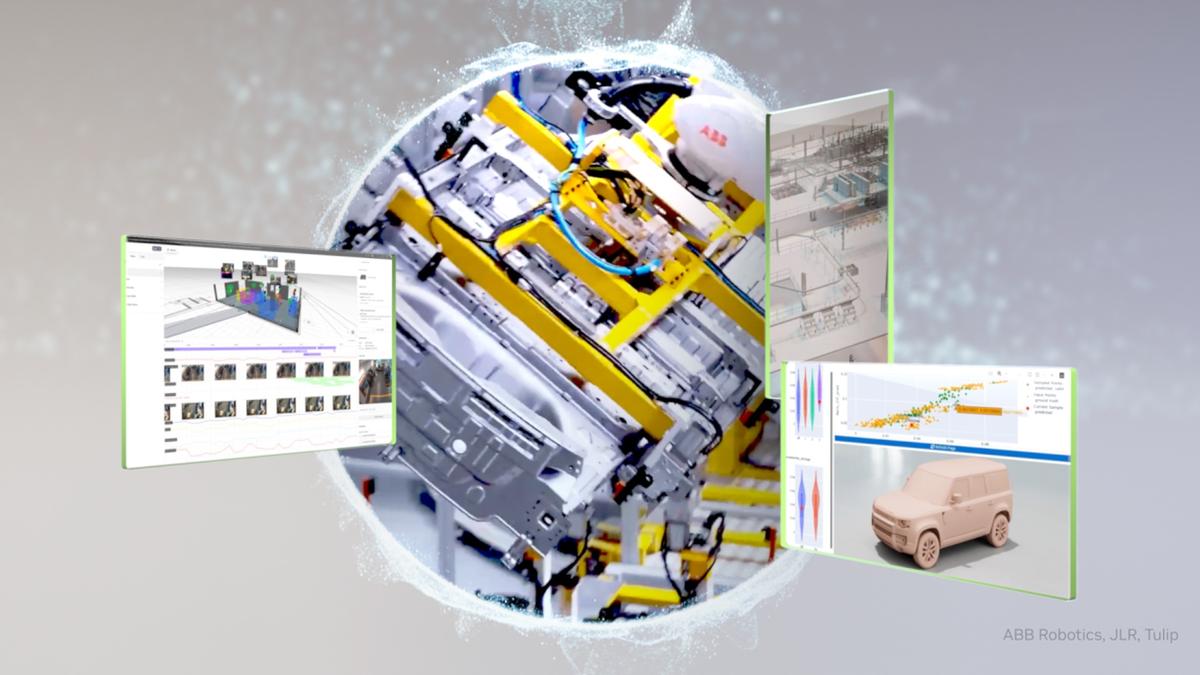
Early adopters illustrate the tangible benefits. ABB Robotics integrated Omniverse libraries into its RobotStudio HyperReality platform, achieving 99% fidelity between virtual and real robots and slashing product introduction timelines by up to half while cutting commissioning time 80% and lifecycle costs 30‑40%. In the automotive sector, Jaguar Land Rover leveraged the same stack to train neural surrogate models on 20,000 CFD simulations, collapsing a four‑hour aerodynamic analysis into a one‑minute real‑time visual loop. Meanwhile, Tulip’s Factory Playback, powered by NVIDIA Metropolis VSS and Cosmos Reason, overlays AI‑driven insights on live camera feeds, delivering a 3% yield lift and a 10% reduction in rework for Terex’s global plants.
Beyond isolated case studies, the broader implication is a new competitive baseline for industrial firms. By embedding physical AI into digital twins, manufacturers can run continuous “design‑simulate‑optimize” cycles, predict equipment failures, and automate quality checks without halting production. The open nature of SimReady and the extensibility of Omniverse libraries also lower entry barriers for smaller players, democratizing access to enterprise‑grade simulation. As more factories adopt this stack, the industry is poised for faster innovation cycles, reduced capital risk, and a deeper integration of AI into every stage of the product lifecycle.
Into the Omniverse: Manufacturing’s Simulation-First Era Has Arrived
Comments
Want to join the conversation?
Loading comments...