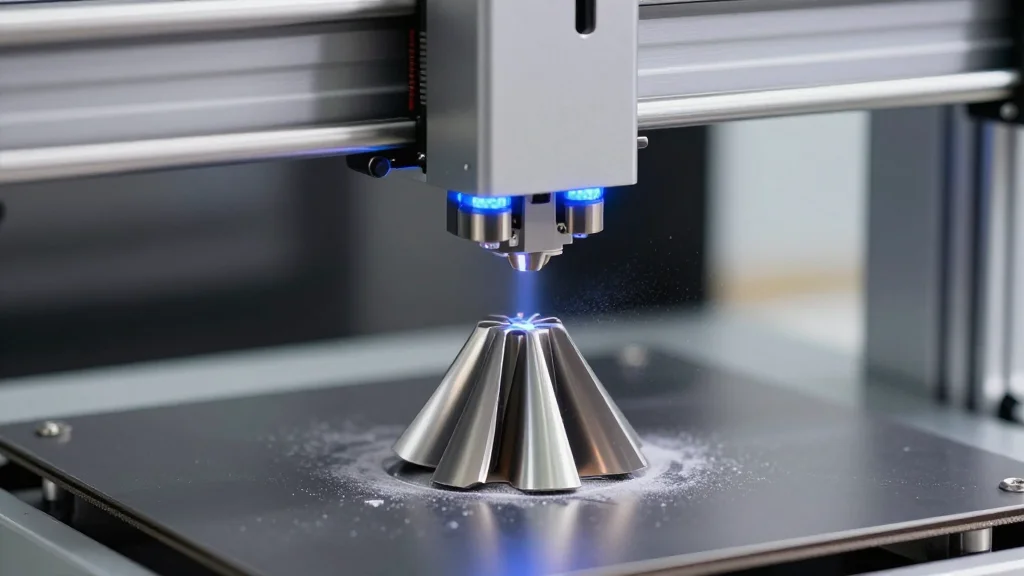
Mastrex Metal 3D Printer Supports Industrial AM Accessibility
Why It Matters
The MX300 and Ceratizit’s advanced cutters reduce production bottlenecks, enabling faster, cost‑effective delivery of critical aerospace and defense components. Their innovations accelerate the adoption of metal additive manufacturing and high‑performance machining across demanding industries.
Key Takeaways
- •Mastrex MX300 offers 300×300×350 mm build volume with dual 500 W lasers
- •Supports titanium, stainless steel, aluminum, cobalt‑chrome, Inconel for aerospace, defense, medical
- •High‑throughput architecture reduces downtime, easing metal AM integration
- •Ceratizit’s MaxiMill cutters use additive‑manufactured bodies for internal coolant channels
- •DirectCooling and high‑feed designs boost tool life and cut rates on superalloys
Pulse Analysis
Metal additive manufacturing is moving from niche prototyping into high‑volume production, driven by demand for lightweight, complex parts in aerospace, defense and medical devices. Mastrex’s MX300 addresses this shift by offering a sizable 300 × 300 × 350 mm build envelope and twin 500 W lasers that cut cycle times without sacrificing surface finish. Its material flexibility—covering titanium, Inconel, cobalt‑chrome and more—allows manufacturers to consolidate multiple processes onto a single platform, reducing part inventories and lead times while maintaining the dimensional accuracy required for safety‑critical applications.
At the same time, machining remains essential for finishing and post‑processing metal AM parts. Ceratizit’s new MaxiMill cutter family integrates additive manufacturing into the cutter body, creating intricate internal coolant channels that conventional machining cannot achieve. The DirectCooling system delivers coolant precisely where heat concentrates, extending tool life and enabling higher cutting speeds on hard-to-machine alloys such as Inconel and titanium. High‑feed variants further increase metal removal rates, cutting cycle times for large structural components and engine parts. These innovations collectively improve productivity and lower operating costs for shops handling aerospace superalloys.
Together, the MX300 and Ceratizit’s advanced tooling illustrate a converging ecosystem where additive and subtractive processes complement each other. Manufacturers can now produce near‑net‑shape metal parts with the MX300 and finish them efficiently using MaxiMill cutters, creating a seamless workflow that shortens time‑to‑market. This synergy is expected to accelerate supply‑chain resilience, especially for defense and aerospace programs that demand rapid iteration and low‑volume, high‑value production. As the industry embraces these integrated solutions, firms that adopt them early will gain a competitive edge in cost, speed and part quality.
Mastrex Metal 3D Printer Supports Industrial AM Accessibility
Comments
Want to join the conversation?
Loading comments...