Maximizing Air Gauge Capability for Small Holes
Why It Matters
The ability to inspect sub‑millimeter holes at high speed improves quality control for critical components such as fuel injectors, medical needles, and aerosol valves, directly impacting performance and safety. Manufacturers gain a scalable, low‑cost solution that eliminates the need for multiple specialized gauges.
Key Takeaways
- •Air gauging can measure holes as small as 0.1 mm.
- •Flow‑based method turns the workpiece into its own gauge tooling.
- •Linearized multi‑transducer systems achieve sub‑10 µm accuracy.
- •Enables high‑volume inspection of deep or blind small‑diameter holes.
- •Reduces need for dedicated short‑range gauges, saving cost and setup time.
Pulse Analysis
Measuring holes smaller than a millimeter has long been a bottleneck for manufacturers that produce high‑precision components. Industries ranging from automotive fuel‑injection systems to pharmaceutical syringes rely on tight bore tolerances to ensure flow consistency, product efficacy, and safety. Conventional inspection tools—optical comparators, microscopes, or precision wire go/no‑go gauges—either lack the speed required for mass production or cannot access deep, blind features. Consequently, many factories resort to costly re‑work cycles or accept wider tolerances, which can erode performance and regulatory compliance.
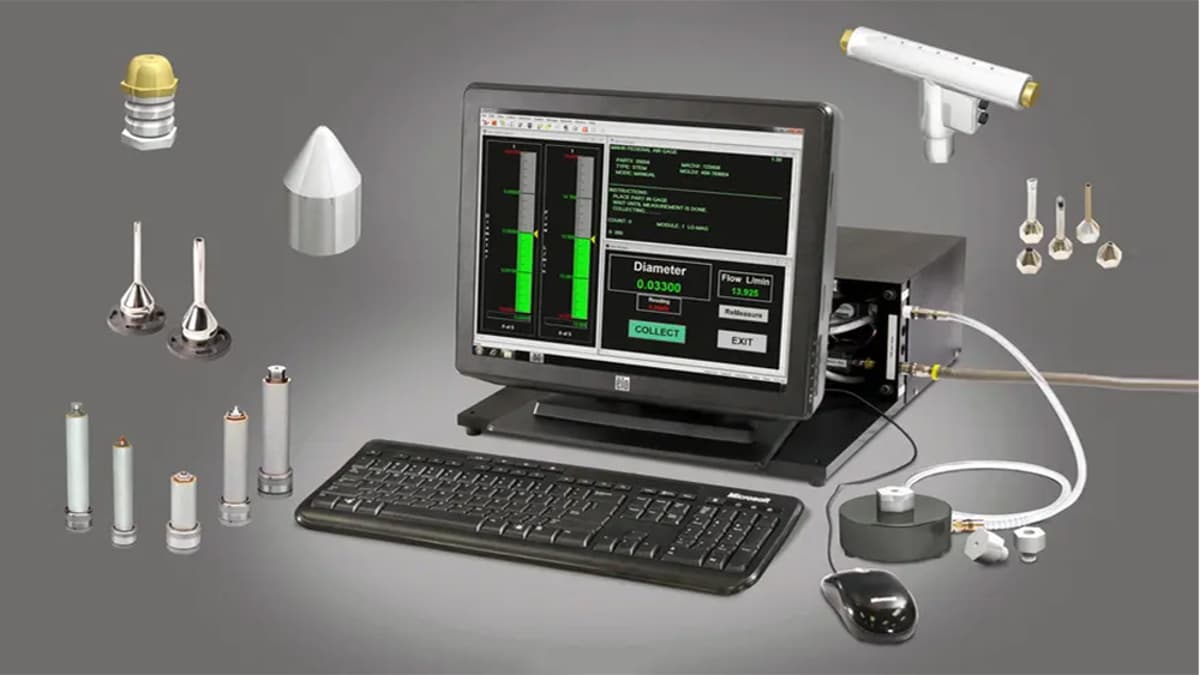
Air gauging sidesteps those constraints by turning pneumatic pressure into a dimensional signal. In the flow‑based variant, the part under test is connected directly to the air line; a smaller bore restricts airflow, producing a measurable pressure drop that correlates with the hole’s cross‑sectional area. Because airflow varies with the square of the diameter, manufacturers embed a gauging computer that selects among several linearized pneumatic transducers, each calibrated for a narrow range. This multi‑sensor architecture delivers repeatable accuracy better than 7.6 µm across the 0.1 mm‑to‑1 mm spectrum while maintaining rapid cycle times.
The flexibility of this approach is reshaping quality‑control strategies on the shop floor. By eliminating the need for dedicated short‑range gauges, plants can consolidate inspection equipment, reduce capital outlay, and simplify change‑over procedures. Moreover, the digital output of the gauging computer integrates seamlessly with Manufacturing Execution Systems, enabling real‑time statistical process control and traceability required by ISO 9001 or FDA regulations. As more OEMs adopt pneumatic multi‑transducer solutions, the technology is poised to become a standard for high‑volume, sub‑millimeter bore verification in the era of Industry 4.0.
Maximizing Air Gauge Capability for Small Holes
Comments
Want to join the conversation?
Loading comments...