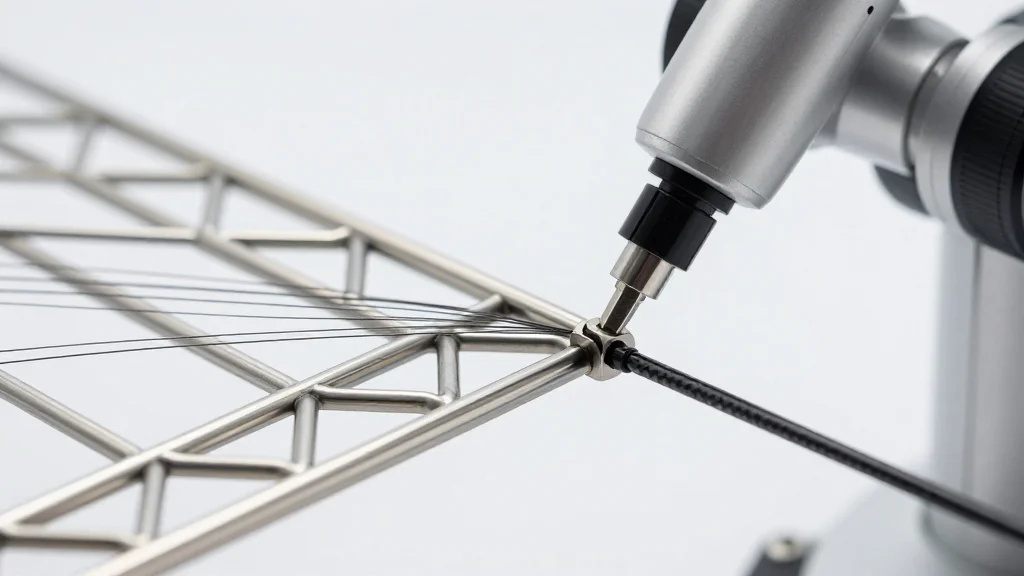
Mesoscale Carbon Fiber Lattice Development Attains Aluminum-Level Performance at 1/100 the Weight
Why It Matters
By collapsing weight without sacrificing strength, the technology can dramatically improve energy efficiency and payload capacity in weight‑critical industries, accelerating adoption of architected composites at scale.
Key Takeaways
- •Continuous carbon fiber lattice cuts weight to 1% of aluminum.
- •Drone frame weight reduced 79%, flight time up 33%.
- •Lattice achieves 10‑30 MPa compressive strength, aluminum‑level specific strength.
- •Process uses 3D node winding and resin consolidation for seamless fibers.
- •Enables scalable robotic fabrication of complex architected composites.
Pulse Analysis
The race for lighter, stronger structures has long been hampered by the trade‑off between material performance and manufacturing complexity. Traditional carbon‑fiber composites rely on stacked laminates or assembled parts, creating weak interfaces that limit design freedom. The Seoul National University team sidesteps these constraints by winding a single continuous fiber through a three‑dimensional scaffold, then impregnating it with resin. This 3D node‑winding approach produces a monolithic lattice where load paths are uninterrupted, delivering aluminum‑comparable specific strength at a fraction of the mass.
Performance data underscore the practical upside. The lattices reach compressive strengths of 10‑30 MPa—on par with low‑grade concrete—yet their specific strength outpaces conventional lattice designs by up to tenfold. In a real‑world test, a drone frame built from the material shed 79 % of its structural weight, translating into a 33 % boost in flight endurance under identical power conditions. Such gains are directly relevant to aerospace and unmanned systems, where every gram saved can extend range, increase payload, or lower fuel consumption. Robotics also stands to benefit, as lighter yet stiff frames enable faster actuation and higher precision.
Beyond the immediate performance gains, the manufacturing method aligns with emerging robotic and AI‑driven fabrication platforms. By encoding complex fiber trajectories into digital toolpaths, factories can produce architected composites without manual lay‑up, opening the door to scalable production of geometrically intricate parts that were previously impractical. As these automated systems mature, industries from aircraft manufacturers to construction firms could adopt the technology to cut material usage, reduce waste, and meet stringent weight targets, reshaping the economics of high‑performance structural design.
Mesoscale carbon fiber lattice development attains aluminum-level performance at 1/100 the weight
Comments
Want to join the conversation?
Loading comments...