Patent Proposes Recycling Thermoset Polymers Into 3D Printing Filaments
Key Takeaways
- •Thermoset waste becomes filler in printable filament
- •Filament contains at least 50% thermoplastic polymer
- •Potential to divert non‑recyclable scrap from landfills
- •Filler may alter stiffness, thermal stability, and cost
- •Printability challenges include nozzle wear and brittleness
Pulse Analysis
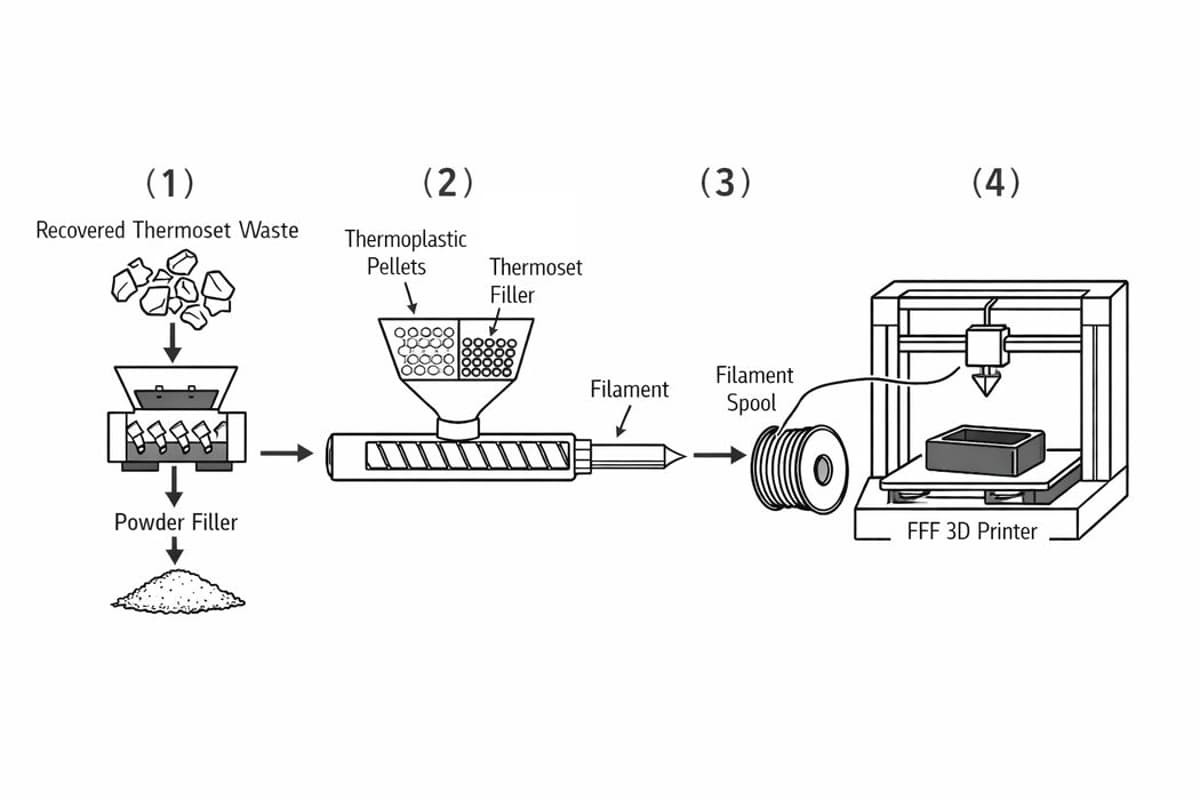
Thermoset polymers—used in automotive parts, electronics, and composite structures—have long posed a recycling dilemma because their cross‑linked molecules cannot be remelted. Traditional disposal routes involve landfilling or energy‑intensive incineration, both environmentally costly. Proterial’s patent introduces a straightforward mechanical recycling loop: grind cured thermoset waste into fine particles, blend them with a thermoplastic carrier, and extrude the mixture into filament suitable for fused‑filament fabrication. By leveraging existing FFF printers, the method could unlock a secondary market for materials that were previously considered waste, aligning with broader circular‑economy goals.
The composite filament design offers more than just waste diversion. Incorporating thermoset filler can tailor mechanical and thermal properties—enhancing stiffness, dimensional stability, and heat resistance—while potentially lowering material costs. Manufacturers of jigs, fixtures, or low‑stress functional parts could benefit from these customized attributes, especially when aesthetic performance is secondary. Moreover, the ability to use a variety of thermoset sources, from epoxy molds to fiber‑reinforced composites, broadens the feedstock pool, making the approach adaptable across multiple industries.
Commercial adoption, however, hinges on overcoming practical challenges. Filler particle size, surface treatment, and compatibility with the chosen thermoplastic matrix will dictate extrusion stability, nozzle wear, and layer adhesion. Excessive filler may render the filament brittle or cause clogging, limiting its use to niche applications. Stakeholders should monitor prototype testing data, scalability of the grinding process, and any emerging standards for recycled filament certification. If these hurdles are addressed, the technology could spawn a new class of sustainable 3D‑printing materials, reshaping supply chains for both additive manufacturing and thermoset‑rich sectors.
Patent Proposes Recycling Thermoset Polymers Into 3D Printing Filaments
Comments
Want to join the conversation?