Plastometrex Launches MultiScale Capability for Thin-Wall and High-Resolution Mechanical Property Mapping
•February 18, 2026
0
Why It Matters
By making thin‑walled and complex geometries testable without sectioning, MultiScale accelerates qualification cycles and reduces safety‑factor conservatism in high‑performance sectors like aerospace and additive manufacturing.
Key Takeaways
- •MultiScale maps properties on 0.75 mm walls.
- •1.5 mm indent spacing enables fine resolution.
- •NASA detected 15% yield drop in thin walls.
- •Supports 250 µm, 500 µm, and 1000 µm indenters.
- •ASTM E3499‑25 standardizes indentation plastometry.
Pulse Analysis
Traditional tensile testing struggles with thin‑walled, welded, or intricately shaped parts because it requires destructive sampling and standardized coupons. Plastometrex’s MultiScale capability sidesteps these constraints by applying a series of micro‑indentations across a component’s surface and using accelerated inverse finite element analysis to reconstruct full stress‑strain curves. This approach delivers reliable mechanical data in minutes, preserving the part for further use and dramatically shortening the time needed for material qualification.
The technical advantage lies in the combination of Profilometry‑based Indentation Plastometry (PIP) with interchangeable indenter sizes, allowing engineers to select the appropriate spatial resolution for a given geometry. The 1.5 mm indent spacing captures fine‑scale variations, as evidenced by NASA’s recent study where a 15 % drop in yield strength was observed as wall thickness decreased. Such granular insight enables rapid feedback loops for additive‑manufacturing process optimization, weld procedure refinement, and the potential to lower safety margins without compromising structural integrity.
Industry adoption is bolstered by the recent ASTM E3499‑25 standard, which formalizes the extraction of stress‑strain data from indentation tests, reducing regulatory uncertainty. Integrated with Renishaw’s production workflows and offered via the CORSICA+ subscription, MultiScale positions Plastometrex as a key enabler for non‑destructive testing in regulated sectors. As manufacturers seek faster, data‑rich qualification methods, the technology is likely to become a staple in aerospace, automotive, and high‑performance engineering pipelines.
Plastometrex launches MultiScale capability for thin-wall and high-resolution mechanical property mapping
Rodolfo Hernández
Rodolfo Hernández is a writer and technical specialist with a background in electronics engineering and a deep interest in additive manufacturing. Rodolfo is most interested in the science behind technologies and how they are integrated into society.
Cambridge‑based materials testing company Plastometrex has introduced a new MultiScale capability for its PLX‑Benchtop system, allowing high‑resolution mapping of mechanical properties across thin, welded, and geometrically complex parts. Announced in February 2026, the update allows engineers to test specimens as thin as 0.75 mm and perform property mapping with 1.5 mm indent spacing, expanding access to stress–strain data in areas that are typically inaccessible to conventional tensile testing.
The MultiScale capability builds on Plastometrex’s ASTM‑standardised Profilometry‑based Indentation Plastometry (PIP) testing method. It uses indentation data and accelerated inverse finite element analysis to extract full stress–strain curves, including yield strength and ultimate tensile strength (UTS), from a single automated five‑minute test.

Testing thin walls and complex geometries without sectioning
Conventional mechanical testing often requires destructive sample preparation and standardised specimen geometries. Thin‑walled parts, welded joints, and additively manufactured components with complex features can be difficult or impossible to evaluate directly.
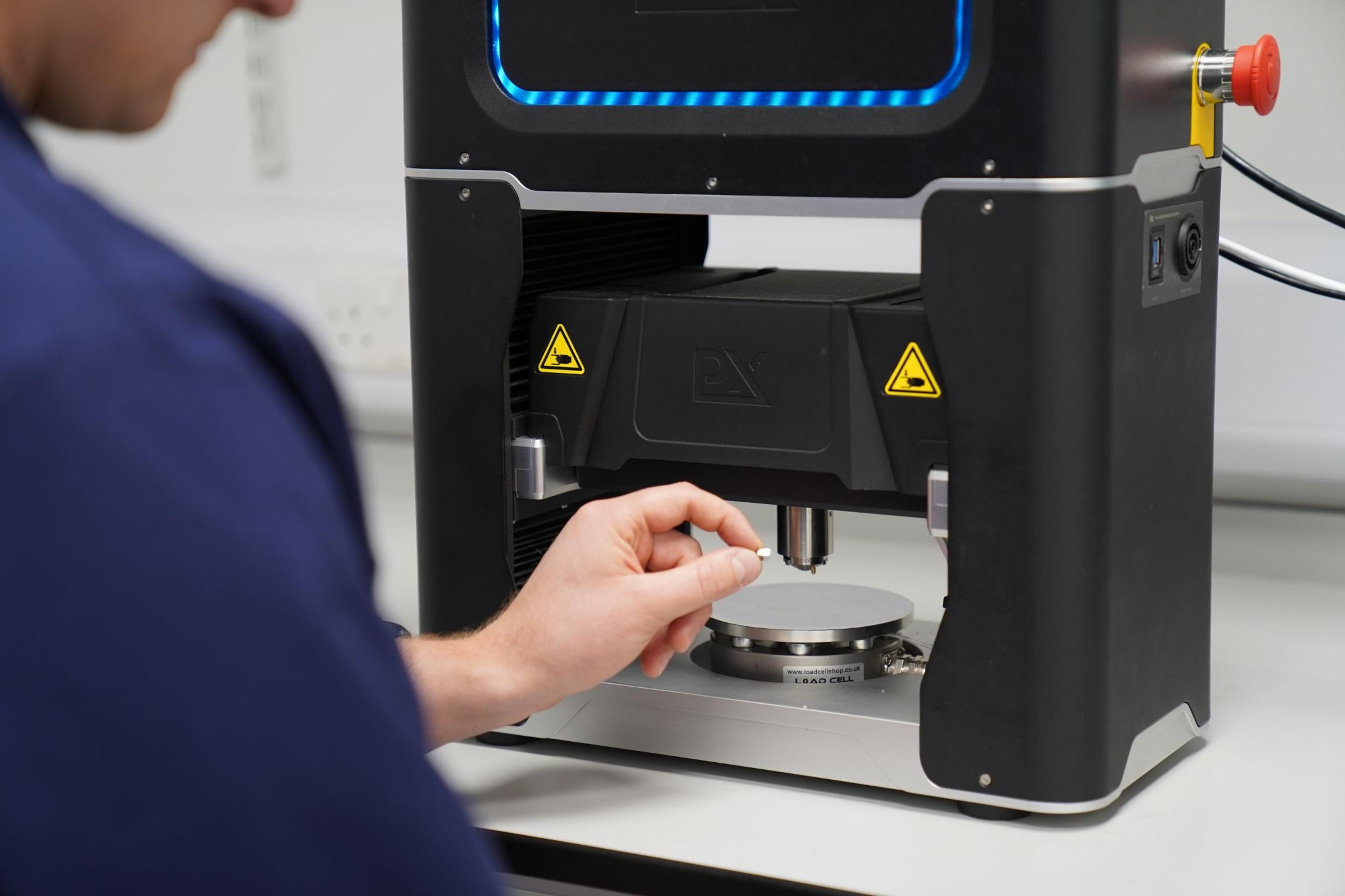
With MultiScale, PLX‑Benchtop users can test directly on components as thin as 0.75 mm without cutting out sections. Alongside the standard 1000 µm indenter, the system also supports 500 µm and 250 µm indenters, allowing mechanical behaviour to be measured at multiple length scales.
Dr Jimmy Campbell, CTO at Plastometrex, said the development tackles a common problem for engineers working with thin or geometrically complex parts. He said the goal was to make it possible to “test the untestable” and get reliable property data wherever it’s needed.

Application in additively manufactured components
MultiScale has already been used by NASA to measure local differences in mechanical properties within a spaceflight component. By mapping stress–strain responses across an additively manufactured part, the method showed links between process, structure, and properties. This helped guide manufacturing improvements and allowed less conservative safety factors.
One reported result found that yield strength dropped by about 15 % as wall thickness decreased. This kind of local variation may be missed by traditional tensile testing, which usually averages behaviour over larger, standardised specimens.
Dr Mike Coto, CCO at Plastometrex, stated that the increased spatial resolution enables users to examine fine‑scale variations that influence overall component performance. He noted that this can support decisions such as adjusting print parameters, refining weld procedures, or reducing unnecessary safety margins while maintaining structural integrity.

Expanding non‑destructive mechanical testing
Plastometrex was founded by former University of Cambridge scientists who introduced the term indentation plastometry. The company’s PIP platform produces stress–strain curves and metal strength parameters from a single indentation test in minutes, providing a non‑destructive option compared with conventional tensile testing.
The MultiScale capability is available to PLX‑Benchtop users through the company’s CORSICA+ subscription.
Standardised indentation testing moves into production workflows
Plastometrex’s Profilometry‑based Indentation Plastometry (PIP) method has already been integrated into industrial additive manufacturing workflows through a collaboration with Renishaw, where the technology was used to accelerate mechanical qualification directly on printed components. That integration demonstrated demand in production environments for faster, non‑destructive alternatives to conventional tensile coupon testing.
The method gained further validation when ASTM International approved ASTM E3499‑25, establishing a standardised procedure for extracting stress–strain data from indentation tests. In regulated sectors, standardisation reduces uncertainty by defining how results are generated and verified. Within that framework, MultiScale does not introduce a new testing approach; it removes a practical limitation by enabling mechanical variation in thin walls and fine geometric features to be measured without destructive sectioning.
Featured image shows PLX‑Benchtop small sample. Image via Plastometrex.
0
Comments
Want to join the conversation?
Loading comments...